
World Cup 2026 Predictions: My Tournament Calls and Value Picks
 Available in US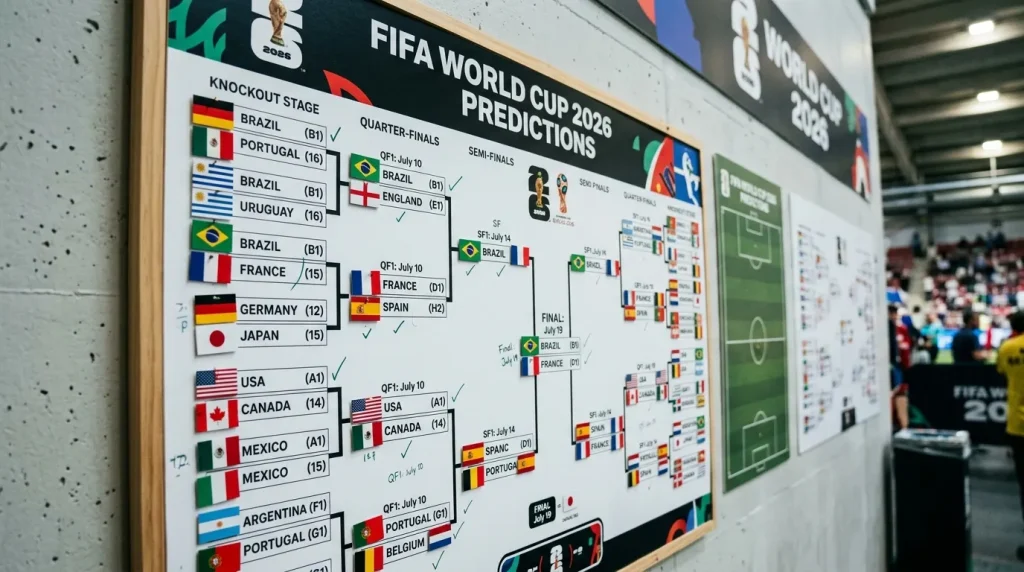
Table of Contents
Every analyst puts their name to a set of predictions before a World Cup. Most hedge. Most offer three or four “could win it” picks and call it analysis. I am not going to do that. What follows are the specific calls I am making for the 2026 FIFA World Cup — winner, dark horse, group stage upsets, golden boot — with the reasoning and the betting angles behind each one. Some of these will look obvious. Some will look contrarian. All of them are positions I am putting money behind, because World Cup 2026 predictions without skin in the game are just pub chat dressed up in a column.
I have covered three World Cups as a betting analyst. I called Morocco’s semi-final run in 2022 as a quarter-final value bet at 21.00, missed on my outright pick of Brazil, nailed the Japan group stage upset of Germany, and badly misjudged Belgium’s collapse. The record is honest, not perfect. That honesty is what makes the exercise worthwhile — I am not selling certainty. I am selling an informed perspective shaped by nine years of watching how tournament football actually behaves versus how the market expects it to behave.
My Winner Pick and Why the Market Disagrees
I am backing France to win the 2026 World Cup. Not Argentina. Not England. France.
The market has Argentina as marginal favourites in most outright books, trading around 5.50-6.00. England sit at roughly 6.50. France are typically 7.00-7.50. That gap between France and the top of the market is, in my view, the single biggest mispricing in the entire tournament.
France have reached the final at two of the last three World Cups. They won in 2018. They lost on penalties to Argentina in 2022 after leading 2-0 and then drawing 3-3 in arguably the greatest final ever played. The squad that Didier Deschamps — still in charge, still maddeningly effective — will take to North America is deeper than the one that went to Qatar. Kylian Mbappe will be 27, in the absolute prime of his career. Aurelien Tchouameni and Eduardo Camavinga give them a midfield engine that can match anyone’s intensity. The defensive depth, even with age concerns around some stalwarts, is replenished by a generation of centre-backs emerging from Ligue 1 academies at a rate that borders on unfair.
The reason the market underprices them is narrative. Argentina have the defending champion storyline and the emotional pull of Lionel Messi’s potential farewell. England have the “golden generation finally delivers” arc. France’s story is less romantic — they are simply very, very good at winning World Cup matches, have been for eight years, and the machine keeps producing. Markets overweight narrative and underweight process. Deschamps’ process is the most reliable in international football, and 7.00 is too long for a team that has been in two of the last three finals.
The Group I draw helps. France face Senegal, Norway and Iraq — a group that demands respect in the opener against Senegal but offers a clear path to qualification without the kind of physical group stage battle that drains squads. Compare that to England in Group L with Croatia and Ghana, or Argentina in Group J where Algeria’s defensive organisation could make life uncomfortable. France have the smoothest route through the group stage, which at a tournament this long — 39 days from opener to final — matters more than people realise.
My outright bet: France at 7.00 or better, 2% of tournament bankroll.
Dark Horse Selection: The Team at 25.00+ I Am Backing
Every World Cup has one. In 2022 it was Morocco. In 2018 it was Croatia. The team that nobody takes seriously until the quarter-finals, when it is suddenly too late to get value. For 2026, my dark horse is Japan.
I can already hear the objections. Japan always impress in the group stage and then crumble in the Round of 16. It happened in 2022 against Croatia — penalties, as usual. It happened in 2018 against Belgium — a last-minute counter-attack that still haunts Japanese football. But this squad is different in one critical way: the European experience base has exploded. At the 2022 World Cup, Japan had around eight players active in Europe’s top five leagues. For 2026, that number will be closer to 18. The entire spine of the team — goalkeeper, centre-backs, central midfielders, attacking players — are playing in the Bundesliga, the Premier League, La Liga and Serie A every week. The technical gap that used to appear in knockout rounds has narrowed to the point where I do not think it exists anymore.
Group F pairs Japan with the Netherlands, Tunisia and Sweden. That is not easy, but Japan’s style — high press, rapid transitions, tactical flexibility under Hajime Moriyasu — is built to exploit European sides that expect them to sit back. They pressed Spain and Germany into mistakes in 2022. The Netherlands, for all their talent, have a defensive vulnerability in transition that Japan are ideally equipped to attack. I think Japan win the group or finish a strong second, and then the bracket opens up.
The bracket matters because the Round of 32 draw for Group F runners-up will likely pit Japan against a third-placed team from a neighbouring group — not an outright contender. If Japan can get past that hurdle, the quarter-final becomes realistic. And in a quarter-final, anything happens. Japan’s odds to reach the semi-finals sit around 17.00-21.00 at most books. To win the tournament outright, they are 34.00-41.00 depending on the operator. I am taking the top-four finish market at around 15.00 — that is my preferred entry point for a dark horse I believe can genuinely reach the semi-finals.
Group Stage Upsets I See Coming
The 2022 World Cup produced four outright group stage upsets where the underdog won at odds of 5.00 or longer: Saudi Arabia beat Argentina, Japan beat Germany, Japan beat Spain, and Cameroon beat Brazil. That is a 6.25% upset rate at those odds — lower than the historical average of around 8-9% across World Cups since 1998, but still enough to blow up every accumulator built on chalk.
With 48 teams and 12 groups in 2026, the number of genuine mismatches increases — but so does the number of “trap” matches where a strong team faces a motivated underdog with nothing to lose. Here are the three specific upsets I think are most likely.
First: South Korea over Mexico in Group A. Mexico will be riding the emotion of the opening match at Estadio Azteca, but their second fixture against South Korea is the dangerous one. Post-emotional-high matches at home World Cups have a historically poor record for the hosts. South Korea are tactically well-drilled under Hong Myung-bo and will treat this as a World Cup knockout match. South Korea to win at around 4.00-4.50 is my pick for the most likely group stage upset.
Second: Senegal over France in Group I. This feels contradictory to my outright pick, and it is — deliberately. France have a pattern of underperforming in opening group matches. They lost to Mexico in 2010, drew with Ecuador in 2014, scraped past Australia 2-1 in 2018, and needed a late winner against Australia again in 2022. Senegal have the athletes to trouble France early in the tournament before Deschamps’ machine hits full rhythm. I would back Senegal double chance at around 2.60, and if France lose the opener but still qualify — as they have done before — my outright position is unaffected.
Third: Australia over Turkiye in Group D. Yes, I am backing the Socceroos. This is not patriotism — it is pattern recognition. Turkiye have not played a World Cup match since 2002. That 24-year gap creates a pressure dynamic that the market cannot price from data alone. The talent is undeniable — Arda Guler, Hakan Calhanoglu — but tournament debut anxiety at the biggest stage in football is real. Australia have played five World Cups in a row and know how to manage the occasion. The opener in Vancouver suits a team that thrives in moderate climates with structured game plans. Australia to win at around 3.50-4.00 is the bet I am most emotionally invested in, and I have checked the analysis three times to make sure the emotion is not driving the pick. It is not.
Golden Boot and Player Specials
The Golden Boot at an expanded World Cup is a volume game. With 104 matches instead of 64, the winner will likely need 7-8 goals. The previous record is 6 — shared by several players across different tournaments. In 2022, Mbappe won it with 8 goals including a hat-trick in the final. The format change creates a structural advantage for players whose teams go deep and who also take penalties, because the extra Round of 32 adds a potential knockout match before the quarter-finals.
My Golden Boot pick is Mbappe. He is the tournament’s best attacker, plays for my predicted winner, and has the penalty-taking duties locked down. France’s path through Group I should produce at least two high-scoring group matches against Iraq and Norway, giving Mbappe a platform to bank early goals. His price has shortened since Qatar — most books have him around 9.00-11.00 — but the value is still there relative to the field. The next most likely candidates, in my assessment, are England’s Harry Kane and Argentina’s Julian Alvarez, but neither has France’s combination of squad depth and likely path depth.
For player specials, I am interested in two markets. First: top Australian goalscorer. The Socceroos’ main striker — whoever earns that starting role in the pre-tournament camps — will be priced in a contained market, and the odds tend to be generous because the bookmakers cannot model the Socceroos’ attacking patterns with the same precision they use for European teams. Second: any player to score a hat-trick during the tournament at around 1.50. With 104 matches and more mismatches than any previous World Cup, the probability of at least one hat-trick approaches certainty. Germany-Curacao, Brazil-Haiti, France-Iraq — any of these could produce a three-goal individual haul. At 1.50, you are getting value on an event I rate as 75%+ likely.
Prediction Questions
Putting My Reputation on the Line
These are the World Cup 2026 predictions I am staking my reputation — and my money — on. France to win the tournament. Japan as the dark horse to reach the semi-finals. South Korea, Senegal and Australia to deliver group stage upsets. Mbappe for the Golden Boot. I will revisit every one of these calls during the tournament, updating the reasoning as the matches unfold and the data accumulates. Some will be wrong. The question is whether the portfolio as a whole generates value across 39 days and 104 matches. I believe it will. Come June, we will find out.
