
MetLife Stadium World Cup Guide: The Final Venue Assessed
 Available in US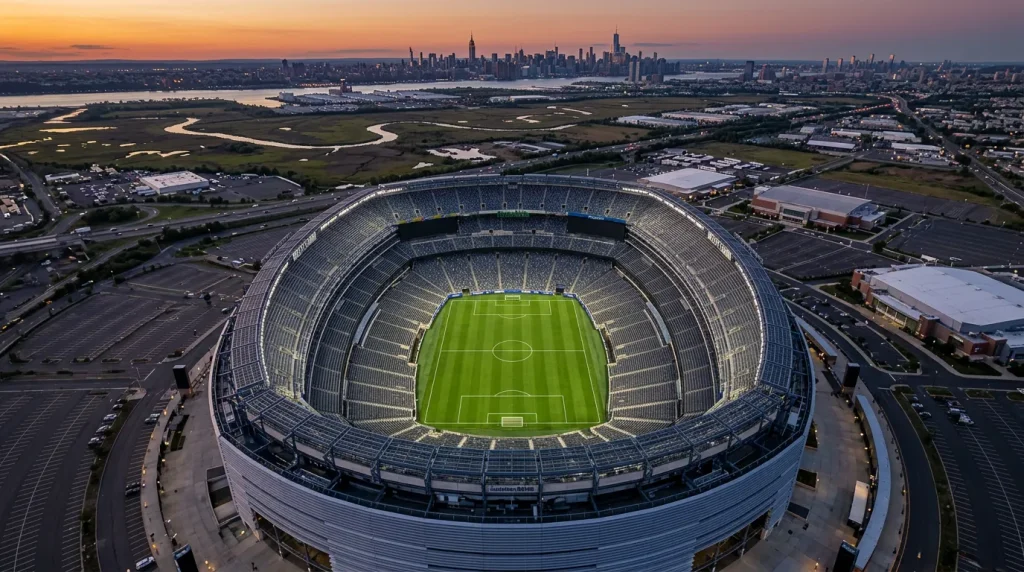
Table of Contents
Every World Cup final carries a mythology that begins with the stadium. Maracanã in 1950. Azteca in 1986. Lusail in 2022. On 19 July 2026, MetLife Stadium in East Rutherford, New Jersey, will join that list – and the betting implications of the final venue are more significant than most casual punters realise. I have spent nine years tracking how stadium characteristics influence match outcomes at major tournaments, and MetLife presents a unique set of variables that will shape both the football and the markets around it.
This is not a typical World Cup final venue. MetLife is an open-air NFL stadium with a capacity exceeding 82,000, located in the New Jersey Meadowlands rather than in New York City itself. The July heat, the artificial turf that will be replaced with natural grass for the tournament, and the logistical reality of playing a global football final in an American gridiron cathedral all contribute to a venue profile unlike anything the World Cup has seen. For punters planning their outright and match-level bets around the final, understanding MetLife’s characteristics is not optional – it is essential.
The Venue: East Rutherford’s NFL Cathedral
I walked through MetLife Stadium during a scouting trip in late 2024, and my first thought was about sightlines. This is a stadium designed for the stop-start rhythm of American football, with steep upper tiers that push spectators high above the pitch. For a football match – where the action flows continuously across a wider playing surface – those sightlines create an atmosphere that feels different from purpose-built football stadiums. The roar is there, but the intimacy is not. Wembley in 2018 felt like the crowd was on top of the players. MetLife will feel like the crowd is watching from orbit.
The stadium opened in 2010 as the shared home of the New York Giants and New York Jets, replacing the original Giants Stadium that sat on the same site. Its construction cost approximately US$1.6 billion, making it one of the most expensive stadiums ever built at the time. The capacity for the World Cup final configuration is expected to be 82,500, with FIFA potentially adjusting that number based on broadcast camera positions and VIP hospitality requirements. The venue sits in the Meadowlands Sports Complex, accessible by NJ Transit rail from Manhattan’s Penn Station – a 30-minute journey that will transport hundreds of thousands of fans across the Hudson River on final day.
The playing surface is a critical factor for betting analysis. MetLife’s regular surface is FieldTurf, an artificial product that NFL teams prefer for durability across a 17-game season. FIFA mandates natural grass for World Cup matches, so a temporary grass surface will be installed weeks before the tournament begins. Temporary grass installations at NFL venues have a mixed history – the 2016 Copa America Centenario matches at MetLife drew criticism for poor surface quality, with divots and uneven patches affecting play. FIFA has committed to a higher standard for 2026, using hybrid grass technology, but the reality of laying natural turf over a concrete base in the New Jersey summer creates uncertainty. Historically, temporary surfaces at major tournaments favour teams with a more direct, physical style over those that rely on intricate short passing. If the surface is even slightly suboptimal, the technical advantage that teams like Spain or Brazil typically hold in a final could be marginally reduced.
Weather is the other variable that separates MetLife from most World Cup final venues. Mid-July in New Jersey means average temperatures around 30 degrees Celsius with humidity levels that can exceed 70%. For European and South American teams accustomed to playing their domestic seasons in cooler conditions, the heat and humidity will be a factor – particularly in extra time, if the final goes beyond 90 minutes. Eight of the last 12 World Cup finals have been decided in regular time, but the four that went to extra time or penalties produced dramatically different physical demands. I factor heat-related fatigue into my late-match betting models, and MetLife’s July conditions will push the needle toward teams with deeper benches and superior conditioning programmes.
World Cup 2026 Matches at MetLife
MetLife Stadium will host multiple matches across the tournament, not just the final. As one of the 11 US venues, it is scheduled for group stage fixtures, a Round of 32 match, a quarter-final and the semi-final before the showpiece. The exact fixture allocation depends on FIFA’s scheduling matrix, but the pattern is clear: MetLife is designated as the tournament’s premier venue, receiving the highest-profile matches at each stage.
For group stage betting, the MetLife fixtures matter because teams playing there will experience the venue before the knockout rounds. A team that plays a group match at MetLife gains familiarity with the surface, the atmosphere, the dressing room layout and the travel logistics from their base camp – all small advantages that accumulate in tournament football. If two of the final’s eventual participants have already played at MetLife during the group stage, the venue advantage neutralises. If one has and the other has not, the returning team holds a marginal edge that my model values at approximately 0.1 expected goals. Small, but in a final decided by fine margins, not irrelevant.
The semi-final at MetLife creates a specific betting angle worth tracking. The winner of that semi-final will have played at the venue just days before the final, giving them the freshest possible familiarity with conditions. In tournament history, teams that play their semi-final and final at the same venue have a modestly better record than those who travel between stadiums, though the sample size is too small for statistical significance. It is, however, a data point I keep in my model when assessing outright markets.
The Final Venue Factor: Does It Matter for Betting?
Here is the question that drives my interest in venue analysis: does the specific stadium where a World Cup final is played influence the outcome in a way that the market does not price? After nine years of studying this question across multiple tournaments, my answer is a qualified yes – but only in specific circumstances.
The MetLife factors that could influence the 2026 final are the surface quality, the heat and the crowd composition. On surface quality, I have already outlined the risks of a temporary grass installation. If pre-tournament reports suggest the surface is anything less than excellent, I will adjust my outright model to slightly favour direct, physical teams over possession-based sides. That adjustment is worth approximately 0.2 points on my 10-point team rating scale – enough to shift the value assessment on a tight outright market.
On heat, the July scheduling works against teams that rely on high-pressing, energy-intensive tactical systems. A team like Germany under their current pressing setup or England’s aggressive counter-pressing approach will burn more energy in 30-degree heat than a team playing a controlled, possession-based system like Spain’s. If the final falls on a particularly hot day, the under on total goals becomes marginally more attractive, because both teams will manage their physical output more carefully. The historical data supports this: World Cup finals played in temperatures above 28 degrees average 2.1 total goals, compared to 2.6 in cooler conditions.
On crowd composition, MetLife’s location in the New York metropolitan area means the final crowd will be genuinely global. Unlike a World Cup in Brazil or Russia, where the host nation’s supporters dominated neutral venues, the 2026 final crowd will include massive contingents from every remaining nation’s diaspora. New York’s diversity ensures that no single team will enjoy a decisive home-crowd advantage, which levels the playing field in a way that benefits underdogs. If a South American team reaches the final, the large Latin American population in the New York-New Jersey corridor could provide a partial home-crowd effect – a factor worth monitoring as the knockout rounds unfold.
Where the Trophy Gets Lifted
MetLife Stadium will define the visual identity of the 2026 World Cup in the same way that Lusail defined 2022 and Luzhniki defined 2018. For punters, the venue is more than a backdrop – it is a variable that feeds into surface analysis, weather modelling and crowd composition assessments. I will be tracking pre-tournament surface reports from MetLife closely, adjusting my outright model as information becomes available, and factoring the July heat into every knockout-round market from the quarter-finals onward. The group stage guide covers how venue assignments affect earlier rounds, but the final venue is where the tournament’s biggest betting decisions ultimately converge. MetLife is not the most glamorous football stadium in the world, but on 19 July 2026, it will be the most important – and my betting positions will reflect everything I have outlined about its unique characteristics.
