
Best World Cup 2026 Betting Markets: A Punter’s Honest Rating
 Available in US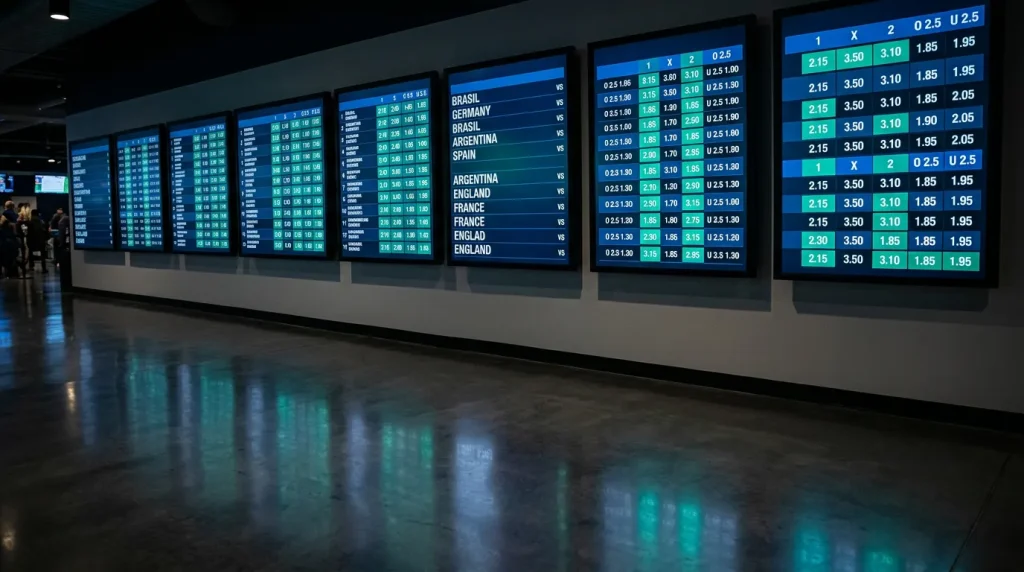
Table of Contents
There is a question I get asked before every major tournament that reveals more about the punter than they realise: “What should I bet on?” Not which team, not which match — which market. The question matters because the 2026 FIFA World Cup will offer more betting markets than any football event in history, and the vast majority of them are designed to take your money, not grow it. A punter who backs the right team in the wrong market is leaving value on the table. A punter who backs the wrong team in the right market might still break even over a tournament. The market you choose is at least as important as the selection you make within it.
Over nine years of covering international tournament wagering, I have developed opinions about every major market type — opinions backed by data, tested across four World Cups and multiple continental championships, and sharpened by the specific constraints that Australian punters face under the Interactive Gambling Act. The online in-play ban means we operate in a pre-match-only environment, which eliminates entire categories of markets available to punters in other jurisdictions and concentrates our opportunities into a narrower window. That constraint is not a weakness. It is a filter that forces discipline, and the best World Cup betting markets for Aussie punters are the ones that reward pre-match analysis over in-play reaction.
What follows is my honest rating of every major market type you will encounter at the 2026 World Cup, scored on a 10-point scale for value and accompanied by the reasoning behind each number. Some of these ratings will be popular. Others will not.
How I Rate a Betting Market
Before the 2018 World Cup, I lost A$400 on a same-game multi that combined a match result, first goalscorer, and correct score. The bet felt clever at the time — three correlated outcomes stacked into a single wager at an eye-catching price. It was, in hindsight, the worst type of bet: high entertainment value, low expected return, and a margin so wide that the bookmaker was essentially charging me a premium for the dopamine hit of a complicated bet slip. That loss prompted me to build a formal rating system for markets, because I realised I had been choosing markets based on excitement rather than edge.
My rating system evaluates each market on four dimensions. The first is analytical edge — the degree to which pre-match research and expertise can meaningfully improve your prediction accuracy beyond the market’s baseline. Markets where the outcome is heavily influenced by factors that can be studied in advance — team form, tactical matchups, historical patterns — rate highly. Markets where the outcome is dominated by randomness — first goalscorer, exact minute of first goal — rate poorly, regardless of how attractive the odds look.
The second dimension is overround efficiency. Every market carries a bookmaker’s margin, but that margin varies dramatically between market types. Match result markets on high-profile World Cup fixtures typically carry a 4-6% overround. Exotic markets — correct score, first goalscorer, time of first goal — can carry 15-25% overround, meaning you are paying a massive premium to play in those markets. A market with a 20% overround requires you to be extraordinarily accurate just to break even, and at a World Cup where randomness is elevated by the unfamiliarity of the 48-team format, that accuracy is harder to achieve than ever.
The third dimension is liquidity and price stability. Markets with high betting volume — outrights, match results, Asian handicaps — tend to have more stable pricing and narrower spreads between bookmakers. Low-liquidity markets — player specials, novelty bets, tournament-specific props — are priced by fewer analysts at the bookmaker, updated less frequently, and more susceptible to sharp moves when a single large bet lands. For the pre-match punter, price stability matters because the odds you see at 9am may not be the odds available at 3pm, and markets that move unpredictably undermine your ability to plan.
The fourth dimension is Australian relevance — specifically, how well the market suits a punter operating under the in-play ban. Markets that derive most of their value from in-play dynamics — next goalscorer, in-play handicap adjustments, live cash-out arbitrage — are structurally disadvantaged for Australian punters. Markets that reward thorough pre-match analysis and do not change character once the whistle blows are where we have our strongest edge. Every rating that follows reflects this four-dimensional assessment, with the scores weighted toward what matters most for an Aussie punter at the 2026 World Cup.
Outright Markets: The Long Game
My rating: 8/10. If I had to choose a single market type to bet on for the entire 2026 World Cup, it would be outrights — not because they offer the highest strike rate, but because they offer the most favourable conditions for a punter who does their homework months before the tournament starts. The outright market is the one arena where time is on your side rather than against you.
The tournament winner market is the flagship outright, and the 2026 edition is the most complex in history. Forty-eight teams means the longest odds tail in World Cup betting — teams like Curaçao, Haiti, and New Zealand priced at 500.00 or higher, representing implied probabilities below 0.2%. Those extreme prices are not bets; they are lottery tickets, and I treat them accordingly. The value in the outright winner market lives in the 8.00 to 25.00 range, where the mid-tier contenders — Spain, the Netherlands, Portugal, the USA — sit at prices that may not fully reflect their tournament probability. Spain at 8.00, for instance, implies a 12.5% chance of winning the tournament. Given their European Championship victory in 2024, their ascending squad age profile, and a group draw that preserves their energy for the knockout rounds, I would argue their true probability sits closer to 14-15%. That 2-3 percentage point gap, compounded across multiple carefully selected outright bets, is how you build a profitable tournament portfolio.
The top-four finish market is where I allocate the largest share of my outright budget. The logic is straightforward: predicting a semi-finalist is significantly easier than predicting the winner, and the prices — typically between 3.00 and 7.00 for contenders — reflect higher probability events with lower variance. At the 2022 World Cup, I placed four top-four finish bets before the tournament started and two of them landed, producing a net positive return across the set. The key is selecting teams with a clear path to the last four based on group draw and likely knockout bracket positioning, not just raw squad quality. A team like England, priced at perhaps 3.00 to reach the semi-finals, might offer less value than a team like the Netherlands at 5.00, if the Dutch draw places them on the weaker side of the bracket.
Beyond winner and top-four markets, the outright category includes a range of proposition bets that reward specific knowledge. The “continent of winner” market — betting on whether the champion comes from Europe or South America — is priced efficiently at most bookmakers because the historical data is abundant: European teams have won the last four World Cups, and South American teams have not won since Brazil in 2002. The “golden boot” market — top scorer — is a higher-variance proposition where the analytical edge is thinner, because goalscoring at a World Cup is influenced by factors that are difficult to model in advance: which matches go to extra time, which teams face weaker opponents in the knockout rounds, which strikers are on penalty duty. I rate the golden boot market at 5/10 within the outright category — fun to have as a side bet, but not a market where I would concentrate serious capital.
The timing of outright bets matters enormously. Prices are longest immediately after the draw, contract as squad announcements approach, and shorten further once the tournament begins. If you identified a value outright bet in January 2026 but waited until June to place it, you likely lost 15-25% of the available edge through price compression. For the 2026 World Cup, the optimal window for outright bets is now — or as close to now as your analysis allows. Every week closer to 11 June narrows the gap between your assessment and the market’s, and the edge evaporates with it.

Match-Level Markets: Where Pre-Match Skill Pays
My rating: 9/10. This is the highest rating I give to any market category at this World Cup, and it reflects a simple truth about Australian betting: when in-play is off the table, the pre-match analysis window becomes your entire competitive arena. Match-level markets — match result, Asian handicap, over/under goals, both teams to score — reward the punter who arrives at kickoff with a thoroughly researched position. The bookmaker cannot adjust the line after the whistle. You cannot chase losses or hedge a deteriorating position. Whatever the pre-match price says, that is the deal. And in that environment, the punter with the best pre-match preparation wins.
The match result market — home win, draw, away win on the 1X2 format — is the simplest and most liquid market at any World Cup. At the 2026 tournament, all matches are played at neutral venues from the perspective of non-host teams, which simplifies the analysis: there is no traditional home advantage factor to model for 45 of the 48 teams. The three host nations — USA, Mexico, and Canada — do carry a home factor, but only when playing in their own country’s venues, which is not guaranteed beyond the group stage. This neutrality makes the match result market more analytical and less noise-driven than at a typical domestic league weekend, where home advantage distorts every price.
The overround on match result markets at the World Cup tends to be tighter than at domestic competitions — between 4% and 7% for high-profile fixtures — which means the bookmaker’s margin erodes less of your edge. That tighter margin, combined with the absence of in-play hedging, creates a market where a well-researched pre-match position has a higher expected return than almost any other market type. I track my match result bets separately from all other categories, and at the last three World Cups, my match result portfolio has been my most consistent positive-return category.
Asian handicap markets deserve particular attention for the 2026 World Cup. The Asian handicap eliminates the draw as an outcome by applying a goal handicap to one or both teams, which reduces the match to a two-outcome bet. For a punter, this is significant because two-outcome markets have a lower overround ceiling than three-outcome markets — the bookmaker can only charge a margin on two options instead of three, which tightens the pricing. At the 2022 World Cup, Asian handicap markets on group stage fixtures carried an average overround of roughly 3.5-4.5%, compared to 5-7% on the equivalent 1X2 markets. That difference sounds small, but across 96 group matches and the extended knockout bracket, it compounds into a meaningful cost saving.
The Asian handicap is also the market that rewards tournament-specific knowledge most directly. In a 48-team World Cup, the group stage produces a high number of mismatches — Germany versus Curaçao, Argentina versus Jordan, Spain versus Cabo Verde — where the three-way match result market prices the favourite so short that there is no value in backing them to win. The Asian handicap, by applying a goal spread, allows you to express the view that the favourite will not just win but win by a specific margin. Germany -3.5 against Curaçao, for instance, is a bet on the scoreline being 4-0 or wider — a proposition that carries meaningful uncertainty and is therefore priced at odds where value can exist.
Over/under goals markets round out the match-level category, and my rating for this sub-market is 7/10. The total goals market is well-understood by bookmakers and typically priced efficiently, which limits the edge available. Where I find value is in the less-trafficked lines — over 3.5 goals instead of the standard over 2.5, or the team-specific totals market where you bet on one side scoring over or under a set number. At the 2022 World Cup, the average group stage match produced 2.67 goals. With 48 teams and a higher number of mismatches in the expanded format, I expect the 2026 average to rise slightly — perhaps to 2.8-3.0 goals per match in the group stage — and if the bookmakers are slow to adjust their lines upward, the over market on specific mismatch fixtures could offer genuine value in the opening round of matches.
The “both teams to score” market is the one match-level market where I urge caution. At a World Cup, minnow teams facing heavyweights often fail to register a single shot on target, let alone score. The “no” option in BTTS markets on mismatch fixtures is typically priced between 1.40 and 1.60, which implies a 62-71% probability — and in my analysis of mismatch fixtures at previous World Cups, the favourite has kept a clean sheet closer to 55-60% of the time. The pricing is tight but not wrong, and the edge is too thin to build a portfolio around.
Exotics and Specials: Fun but Dangerous
My rating: 5/10. I am going to say something that will be unpopular with bookmakers but honest with you: exotic and special markets exist primarily to make money for the operator, not the punter. They are engineered to be entertaining, to generate social media screenshots, and to create the illusion that a complex, multi-variable bet is somehow more sophisticated than a simple match result selection. It is not. Complexity in betting does not correlate with profitability. If anything, the correlation runs in the opposite direction.
The correct score market is the most visible exotic at any World Cup. Predicting the exact final score of a match — 2-1, 0-0, 3-2 — is a task that combines genuine analytical skill with an enormous dose of randomness. The number of possible scorelines in a football match is effectively limitless, and bookmakers price the most likely outcomes at odds between 6.00 and 12.00 while burying the long tail of unlikely scorelines at prices north of 50.00. The overround on correct score markets is savage — typically between 15% and 30% — because the bookmaker can spread their margin across dozens of outcomes without any single price looking unreasonable. At a World Cup, where the range of match quality varies from Argentina-France to Haiti-Curaçao, the correct score market is even harder to exploit because the data you need to calibrate your model — recent head-to-head results, tactical matchup history — often does not exist for these specific fixture combinations.
First goalscorer markets are the crowd favourite, and I understand why: picking the player who scores first in a World Cup match creates an emotional investment that persists for 90 minutes. From a value perspective, however, first goalscorer is one of the worst markets in the tournament. The outcome is determined by a combination of factors that are extremely difficult to model: who takes the first corner, who wins the first free kick in a dangerous area, which centre-back heads the first set piece. The bookmaker prices each eligible player at odds that collectively produce an overround of 20-30%, and the punter’s ability to outperform the market’s assessment of each player’s probability is minimal. I have tracked my first goalscorer bets across four tournaments, and the strike rate has never exceeded 12% — which, at average odds of 7.00, produces a long-term loss even when you occasionally land a winner.
Tournament-specific specials — the “most yellow cards” market, the “which group produces the most goals” proposition, the “number of red cards in the tournament” bet — are novelty wagers that carry entertainment value and almost zero analytical edge. The outcomes are determined by referee assignments, match dynamics, and random variance to a degree that makes prediction functionally impossible. I have never placed a serious bet on a tournament special, and I would not recommend doing so at the 2026 World Cup. The overround on these markets is the widest in the entire betting catalogue — often exceeding 30% — and the analytical tools available to the punter are blunt at best.
The one exception within the exotics category that warrants attention is the “match to go to extra time” market in the knockout rounds. This is a binary proposition — yes or no — with a clear analytical framework. At World Cups since 2002, approximately 25-30% of knockout matches have gone to extra time. The market typically prices the “yes” option at odds between 3.00 and 4.00, implying a 25-33% probability, which is broadly consistent with the base rate. Where value can emerge is in specific fixtures where the stylistic matchup favours a cagey, low-scoring contest — two defensively organised teams, a classic “fear of losing” knockout dynamic. If your analysis suggests a particular Round of 32 or quarter-final fixture has a higher-than-average probability of reaching 120 minutes, the extra time market can offer genuine value at a price that other exotics cannot match.
Building World Cup Multis That Don’t Blow Up
My rating: 7/10, with a caveat the size of a football pitch. Multis — what Americans call parlays and the British call accumulators — are the most popular bet type in Australia by volume. They are also, statistically, the most consistently unprofitable bet type for the punter. The mathematics are unforgiving: each leg you add to a multi multiplies the bookmaker’s margin, so a five-leg multi at 5% overround per leg is effectively carrying a 25% embedded cost before you even assess whether your selections are right. Most multi punters know this in the abstract and ignore it in practice, because the allure of combining five “certainties” into a single massive payout is too strong to resist.
I give multis a 7/10 not because they are inherently good value — they are not — but because the 2026 World Cup creates specific conditions where disciplined multi construction can work. The expanded format produces 96 group stage matches, many of which feature heavy mismatches where the favourite’s win probability exceeds 70%. Combining two or three of these high-probability legs into a short multi produces a combined price that maintains a reasonable expected return while offering a meaningful uplift on any single bet. The key word is “short” — I never build a World Cup multi with more than three legs, and each leg must individually pass my value filters before it earns a place in the combination.
My multi construction method follows three rules. Rule one: every leg must be independently profitable. If a selection does not offer value as a standalone bet, it does not improve by being added to a multi — it degrades the entire ticket. I assess each potential leg as if it were a single bet, applying the probability gap and overround filters from my World Cup 2026 odds guide, and only selections that pass both filters are eligible for inclusion. This eliminates the most common multi mistake, which is padding the ticket with “safe” short-priced legs that carry no edge and quietly erode the portfolio’s expected return.
Rule two: avoid correlated legs unless the correlation works in your favour. Backing Germany to beat Curaçao and the over 2.5 goals in the same match is a correlated multi — if Germany win, the match is more likely to produce goals, so the two outcomes are not independent. Bookmakers have become increasingly sophisticated at detecting and adjusting prices for correlated multis, which means the combined odds on your ticket may already reflect the correlation, leaving you with no additional value. Where correlation can help is when you combine outcomes across different matches that are linked by a common factor the bookmaker has not fully priced. For example, backing two South American teams to win their group stage openers is a correlated multi if you believe that South American qualifying form translates more effectively to World Cup performance than the market expects — but the bookmaker has not priced the cross-match correlation because the legs are in different fixtures.
Rule three: size the stake inversely to the number of legs. A two-leg multi at combined odds of 4.50 gets a larger stake than a three-leg multi at 9.00, even though the three-leg payout is higher. The reason is variance management: the more legs in the multi, the lower the probability of all legs landing, and the larger the sample size you need for the expected value to materialise. Over a single World Cup — 39 days, 104 matches — you do not have enough repetitions for a high-leg multi strategy to overcome short-term variance. Keeping the legs short and the stakes proportional ensures that a single failed multi does not wipe out the gains from your singles and doubles portfolio.
At the 2022 World Cup, I placed seven multis across the group stage — all two or three legs, all composed of individually value-assessed selections. Three landed, producing a net return of roughly 18% on the multi sub-portfolio. That is not spectacular, but it is positive, and over multiple tournaments, a consistently positive multi return is rare enough that most professional punters would be satisfied with it. The World Cup multis strategy page goes deeper into leg selection and stake sizing for anyone who wants the full methodology.
Betting Market Questions
Market selection generates more confusion than any other aspect of World Cup betting, especially for punters who are used to domestic league wagering where the menu is smaller and the dynamics are more familiar. These are the questions I field most often.
My Market Pecking Order for This Tournament
After nine years and four World Cups, my market hierarchy has crystallised into something I trust enough to put in writing. Match-level markets — match result, Asian handicap — sit at the top at 9/10, because they reward the pre-match analytical discipline that the Australian regulatory environment demands. Outright markets follow at 8/10, with the caveat that timing is everything and early entry is the primary edge. Multis earn a 7/10 when constructed with discipline — short legs, independently value-assessed selections, and stakes sized to survive the inevitable losses. Exotics and specials land at 5/10, serving primarily as entertainment with occasional pockets of value in specific knockout-round propositions.
The 2026 World Cup will test this hierarchy. A 48-team tournament with an untested format, three host nations, and 104 matches across 39 days is an unprecedented environment for sports betting. The bookmakers are extrapolating from 32-team data. The punters are carrying assumptions from previous cycles. And the tournament itself — with its expanded knockout bracket, its third-place qualification pathway, and its concentration of mismatches in the group stage — will produce dynamics that nobody has modelled because nobody has observed them at this level.
That uncertainty is your opportunity. The best World Cup betting markets are the ones where uncertainty is highest and the bookmaker’s model is weakest, because that is where the gap between their price and the true probability is widest. Match results in mismatch fixtures, group winner markets in competitive pools, Asian handicaps where the spread is set against limited data — these are the battlegrounds where your analysis matters most. The exotics will tempt you. The outrights will excite you. But the match-level markets, bet after bet after bet across 104 fixtures, are where the 2026 World Cup will be won or lost for the educated Australian punter.
