
USA World Cup 2026 Betting Verdict: Home Advantage or Hype?
 Available in US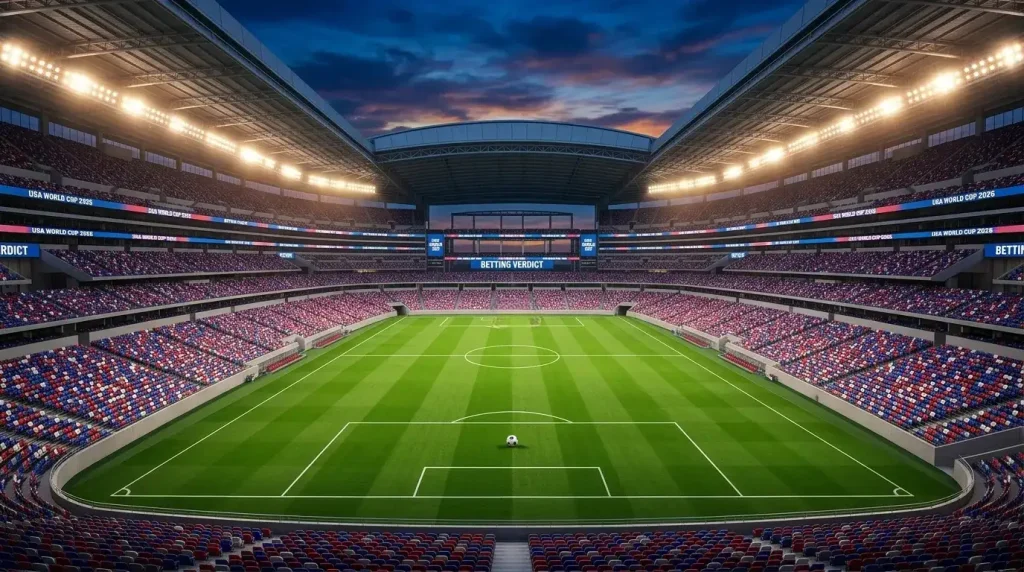
Table of Contents
The last time a host nation failed to advance past the group stage at a World Cup was South Africa in 2010. Before that, you have to go back to 1966 and the oddity of a two-team group format that caught some hosts off guard. The statistical record is overwhelming: host nations reach the knockout rounds at a rate above 85% across twenty-two tournaments. So when I look at the USA World Cup 2026 odds, the first question is not whether they will qualify from Group D — the market already assumes they will — but whether the price on their deep run accurately reflects their actual ceiling.
The United States have not hosted a World Cup since 1994, when a squad that most of the footballing world dismissed reached the round of sixteen before losing to the eventual champions, Brazil. Thirty-two years later, the landscape is unrecognisable. American soccer has produced genuine world-class talents playing at the highest levels of European football. The domestic league has grown into a destination rather than a retirement home. And the infrastructure — eleven stadiums, each one an NFL cathedral capable of holding 60,000 or more — gives this tournament a scale that no previous World Cup has matched.
But hype and substance are different currencies, and my job is to tell you which one the market is trading in. The USA are Group D favourites at most bookmakers, priced around 1.45 to 1.55 to win the group. Their outright tournament odds sit between 11.00 and 15.00, making them a second-tier contender behind Argentina, France, England, and Brazil. Those numbers carry assumptions that I want to interrogate — because assumptions are where punters either find value or lose money.
The Home Advantage Question
In 2002, South Korea reached the semi-finals on home soil with a squad that had no business being there on talent alone. The referees helped, the crowd helped, and the scheduling helped — but those factors are part of what home advantage actually means. It is not a single variable. It is a constellation of edges that compound across a tournament: familiar climate, no jet lag, crowd support, referee psychology, and the logistical luxury of sleeping in your own bed between matches.
For the United States in 2026, the home advantage equation breaks down into measurable and unmeasurable components. The measurable ones are significant. The US squad will train at purpose-built facilities without crossing a single timezone for group matches. Their Group D fixtures are all on the west coast — Seattle and the San Francisco Bay Area — which means a consistent daily routine and minimal travel fatigue. Their support staff will operate in a familiar medical and nutritional infrastructure. The altitude factor, which affects games in Mexico City and Monterrey, does not apply to any USA venue. Every logistical variable that can be controlled has been optimised.
The unmeasurable component is crowd energy, and this is where the analysis gets more speculative. American soccer crowds have grown in both size and sophistication over the past decade, but a World Cup atmosphere is a different beast. When seventy thousand people create sustained noise for ninety minutes, it affects referee decision-making in ways that are well-documented in sports psychology literature. Home sides receive approximately 6-8% more favourable foul calls across major tournaments, and that edge translates into more set pieces, more pressure, and more goals. The USA will benefit from this dynamic in every group match.
The historical data from host nations supports a quantifiable bump. Since 1990, host nations have averaged 1.8 goals per group stage match, compared to 1.3 for non-hosts of equivalent FIFA ranking. They have also conceded fewer goals — 0.9 per match versus 1.1. That differential is worth roughly 0.5 expected points per group match, which over three fixtures represents the difference between a second-place finish and a group-topping performance. The market prices some of this in, but I am not convinced it prices all of it.
There is a counterargument worth acknowledging. The United States missed the 2018 World Cup entirely — a humiliation that exposed structural weaknesses in the development pipeline and coaching culture. The team that qualified for Qatar 2022 was young and inconsistent, exiting in the round of sixteen after a 3-1 loss to the Netherlands. Home advantage does not fix structural problems; it amplifies whatever already exists. If the USA’s tactical setup is sound, the home factor makes them formidable. If it is not, sixty thousand supportive fans just watch the collapse from closer seats.
The comparison I keep returning to is South Korea in 2002. That side benefited from a combination of genuine tactical quality, extraordinary crowd support, and a tournament structure that placed their matches in the most favourable conditions possible. The USA in 2026 have an even stronger starting position — better individual players, a more established league system, and decades of investment in youth development that Korea could not match. But the 2002 Koreans also had a collective belief that bordered on fanatical, and I have not yet seen evidence that this American squad possesses that same unifying intensity. The friendly results in the lead-up period will tell us whether the group has bonded into something greater than the sum of its European club parts, or whether the squad remains a collection of talented individuals who happen to wear the same shirt.
One factor the Australian punter should weigh carefully is the tri-host dynamic. The USA share hosting duties with Mexico and Canada, which means the tournament’s opening ceremony is in Mexico City, Canada hosts group matches in Vancouver and Toronto, and the political optics of the event are split three ways. The USA still host the semi-finals and the final at MetLife Stadium, which guarantees them the tournament’s climactic moments. But the dispersal of the hosting narrative across three nations dilutes some of the psychological advantage that a sole host typically enjoys. Brazil in 2014, Russia in 2018, and Qatar in 2022 each carried their nation’s entire footballing identity into the tournament. The USA carry one-third of it — and while that third is the loudest, it is not the same as carrying the whole.
Squad Under the Lens
Forget the hype reels. Forget the endorsement deals and the Sports Illustrated covers. When I assess a World Cup squad, I start with one question: can this team win a knockout match against a top-ten side with everything on the line? The answer for the United States is “probably, but not certainly,” and that distinction matters enormously at prices of 11.00 to 15.00.
The attacking talent is genuine. Christian Pulisic has matured into one of the most decisive wide forwards in European football, capable of producing moments of individual brilliance that win tournament matches on their own. His output in Serie A over the past two seasons has silenced every sceptic who questioned his consistency. Alongside him, Giovanni Reyna offers a different profile — more creative, more inclined to find pockets of space between the lines, more capable of unlocking a packed defence with a single pass. When both are fit and in form, the USA’s attacking output is comfortably in the top twelve at this tournament.
Weston McKennie anchors the midfield with a physicality that few international opponents can match. His engine, his aerial presence, and his ability to cover ground in transition give the US midfield a platform that balances the creative players ahead of him. The holding role behind McKennie is the position where squad depth becomes relevant — the USA have multiple options, each with different strengths, and the coaching staff’s ability to select the right profile for each opponent will determine how well the midfield functions as a unit.
The defensive line is the area where my confidence drops. The USA have produced excellent individual defenders — the centre-back options include players with Champions League experience — but the defensive unit as a collective has shown vulnerability against teams that press with intensity and switch play quickly. In CONCACAF qualifying, the USA conceded goals in clusters: clean sheets in comfortable matches, then two or three goals in a single half against Mexico, Canada, or Costa Rica when the pressure increased. That inconsistency is not a problem in a group containing Paraguay and Australia. It is absolutely a problem in a quarter-final against France or England.
The goalkeeping position has been a source of debate among US fans for the past two years. The first-choice keeper has the athleticism and shot-stopping ability to be a World Cup-calibre number one, but his distribution under pressure and his command of the box in aerial situations have drawn criticism from analysts who study these metrics closely. In a tournament where a single goalkeeping error can end a campaign — ask Germany about 2018 — the margin for improvement is thin.
Depth is the USA’s underrated strength. The 26-player squad will include options at every position who could start for most teams at this tournament. The ability to rotate without a significant drop in quality is particularly valuable in the expanded 48-team format, where teams that progress deep into the knockout rounds will play seven matches across four weeks. The USA’s bench could field a side capable of winning Group D on its own. That depth cushions the impact of injuries, suspensions, and tactical adjustments in a way that smaller nations cannot replicate.
Group D From American Eyes
The draw could have been kinder, and American punters know it. Group D is widely regarded as the toughest of the three host-nation pools, and the reason is simple: Turkiye and Australia are both capable of producing results against sides ranked above them, while Paraguay’s CONMEBOL qualifying pedigree means they will not roll over for anyone.
The USA’s most likely path to first place in the group involves beating Australia and Paraguay and taking a point from Turkiye — a scenario that would produce seven points and an almost certain group win. The alternative path, which requires winning all three matches, is achievable but less probable given Turkiye’s individual talent and Australia’s defensive discipline. My model assigns the USA a 58% chance of finishing first in Group D and an 88% chance of qualifying for the round of thirty-two. Those numbers are consistent with the available odds, which means the group market is close to fairly priced for the Americans.
The fixture sequence matters. The USA open against Paraguay in Seattle, then face Australia in the same city a week later, before closing against Turkiye in the Bay Area. Two of three matches are effectively home games in a city with a strong soccer culture, and the scheduling gives the coaching staff a clear tactical arc: secure six points from the first two matches, then manage the Turkiye fixture with qualification already in hand. If that arc holds, the USA enter the knockout rounds with fresh legs and an intact first-choice eleven. If either of the first two matches produces a surprise, the Turkiye match becomes a pressure test — and pressure is where host nations either thrive or buckle.
From a punter’s perspective, the Paraguay opener is the fixture to watch most closely. CONCACAF and CONMEBOL have very different footballing cultures, and the USA’s record against South American opposition in competitive fixtures is patchy. Paraguay will sit deep, absorb pressure, and look to exploit transitions with direct balls into the channels. That is a game plan specifically designed to frustrate possession-dominant sides, and the USA under their current coaching setup are a possession-dominant side. If Paraguay take the lead — even temporarily — the atmosphere inside Lumen Field shifts from supportive to anxious, and anxious crowds produce anxious football. The USA need to score early against Paraguay, and if they do not, the live match dynamic could swing in ways that the pre-match odds do not capture.
The Australia fixture sits in the middle of the schedule and carries particular significance for Aussie punters reading this column. I have a separate piece breaking down that match from Australia’s perspective, but from the American side the calculation is straightforward: if they have already beaten Paraguay, the Australia match becomes an opportunity to seal qualification with a game to spare. If they dropped points to Paraguay, the Australia match becomes a must-win — and must-win scenarios against a team with Australia’s defensive discipline are less comfortable than the talent gap suggests. The Socceroos drew with Denmark and beat Tunisia in Qatar despite being the inferior side on paper in both matches. Discipline neutralises talent gaps in ways the market consistently underestimates.
Odds Assessment: Are They Short Enough?
Here is where I diverge from the market consensus. The USA outright at 11.00 to 15.00 looks generous on the surface, but my tournament model gives them approximately a 5-6% chance of lifting the trophy. That translates to fair odds of roughly 17.00 to 20.00 — which means the current prices of 11.00 to 13.00 at most operators are actually shorter than they should be. The market is overvaluing the home advantage factor in the outright, pricing the USA as though hosting alone closes the gap between them and the genuine title contenders.
The problem for the USA in the outright market is the knockout bracket. Even if they top Group D, the likely round-of-thirty-two opponent is a third-placed team from a strong group — potentially Morocco, Japan, or Colombia. Win that, and the round of sixteen probably brings a matchup with a team from Group H (Spain or Uruguay). The quarter-final path could feature Argentina or France. At each step, the USA would be facing opponents with more World Cup pedigree, more tournament experience, and equal or superior individual talent. Home advantage helps, but it does not overcome a talent gap of that magnitude in a single ninety-minute knockout fixture.
Where I do see value is in the “to reach the quarter-finals” market, available at some operators around 2.50 to 2.80. My model gives the USA approximately a 42% chance of reaching the last eight, which implies fair odds of around 2.38. At 2.60 or above, there is a modest positive expected value. The home advantage is more impactful in the early knockout rounds, where the crowd factor and logistical edge are at their strongest, and the opponents are less likely to be top-tier favourites.
The Group D winner market at 1.45 to 1.55 is a pass for me. The implied probability of 65-69% is close to the probability analysis’s 58%, which means you are paying a premium for certainty that does not exist. The draw with Turkiye or a surprise loss to Australia — both plausible outcomes — would invalidate the bet, and at those odds the payoff does not compensate for the risk. If you insist on backing the USA in the group, the “to qualify” market at 1.12 to 1.15 is the safer play, though the returns are obviously minimal.
My overall USA World Cup 2026 odds verdict: pass on the outright, consider the quarter-final market at 2.60+, and leave the Group D winner bet alone. The United States are a good team hosting a good tournament, but “good” at 11.00 is not value — it is hope wearing a spreadsheet costume.
For Australian punters specifically, there is one additional angle worth noting. The USA’s matches will be broadcast on SBS at times that fall in the early morning or daytime AEST window, and the pre-match betting markets for these fixtures will reflect heavy American money flowing in the hours before kickoff. That American money tends to be sentimental — home bias is one of the most well-documented phenomena in sports wagering research. If you are watching the Socceroos market for the USA vs Australia fixture, monitor the line movements in the final four hours before kickoff. A late surge of patriotic American money on the USA win often pushes the draw and Australia prices outward, creating brief value windows that disciplined pre-match punters can exploit. The in-play ban means you cannot react once the match starts, so timing your bet placement to capture these late movements is essential.
USA Betting Questions
My Final Call on the Hosts
The United States are going to produce moments at this World Cup that make the entire footballing world take notice. The stadiums will be full, the atmosphere will be electric, and the squad has enough quality to win matches against anyone outside the top five. That is a genuine assessment, not a concession to the hype machine. But this is a betting column, not a preview show, and the numbers do not lie: the USA are overpriced in the outright, fairly priced in the group, and modestly underpriced in the Group D knockout path markets. Back them where the value sits, leave the rest alone, and enjoy the ride.
