
World Cup 2026 Odds Guide: Reading the Market Like a Professional
 Available in US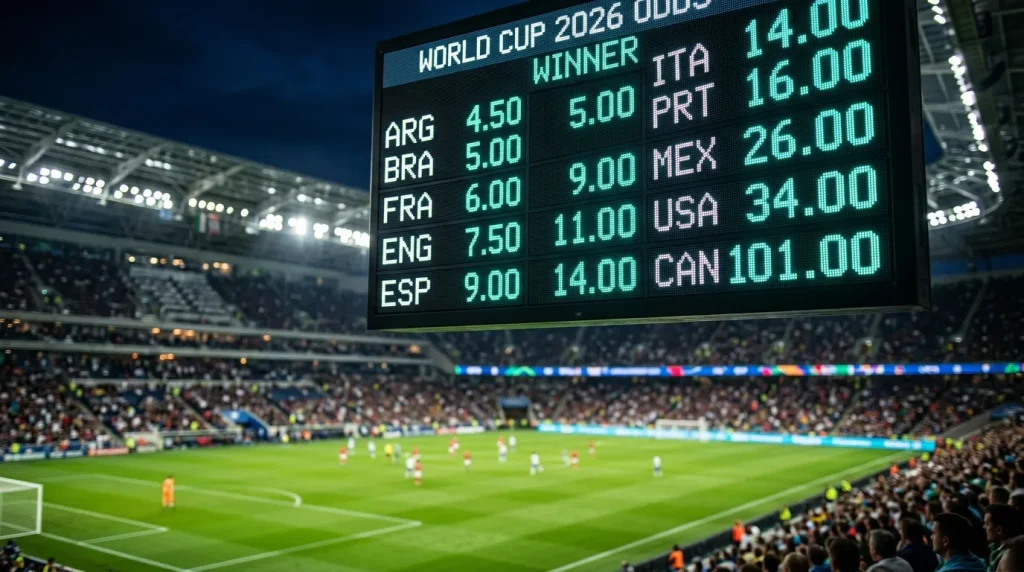
Table of Contents
Nine years of covering international tournament wagering markets has taught me one uncomfortable truth: most punters lose money not because they pick the wrong teams, but because they misread the numbers staring them in the face. I have watched sharp bettors in Sydney and Melbourne consistently extract value from World Cup markets while recreational punters throw cash at short-priced favourites without understanding what those prices actually mean. The difference between the two groups is not luck, and it is not insider knowledge. It is literacy — the ability to read odds the way a bookie writes them.
The 2026 FIFA World Cup presents the most complex betting landscape in tournament history. Forty-eight teams across 104 matches in three host nations means the volume of available markets will dwarf anything we saw in Qatar. For Australian punters working exclusively with decimal odds and navigating the online in-play ban, the pre-match window is everything. The numbers you see on your screen before kickoff are the only battlefield you get, and if you cannot decode what those numbers are telling you — and more importantly, what they are hiding — you are walking into a 39-day tournament with a blindfold on.
This guide is my attempt to hand you the toolkit I wish someone had given me a decade ago. Not a glossary of terms you could find anywhere, but a working system for turning World Cup 2026 odds into actionable intelligence. I will walk you through decimal odds mechanics, implied probability, the markets that matter at a tournament, my personal three-filter system for spotting value, and the timing strategies that separate professional punters from the rest of the field.
Key Facts Before You Place a Punt
A colleague in Perth once told me he had been betting on football for six years before he realised that decimal odds of 2.00 did not mean “double your money” in the way he assumed. He thought a A$50 bet at 2.00 returned A$50 profit plus his A$50 stake — A$100 total. He was right about the maths but wrong about what it meant, because he had never factored in that the bookmaker’s own assessment of that outcome was roughly 50%, not the “certainty” he felt in his gut. That gap between feeling and probability is where every dollar you have ever lost on a punt disappeared to.
Before diving into the mechanics, here is the landscape you are operating in. Australian bookmakers display all odds in decimal format — 1.50, 3.25, 7.00 — which represents the total return per dollar staked, including your original stake. A decimal price of 3.00 on Brazil to beat Haiti means a A$100 bet returns A$300 total if it lands: A$200 profit plus your A$100 back. This format is cleaner than the fractional system used in the UK or the American plus/minus format, and it makes direct comparison between markets far simpler. Every licensed Australian operator — from the largest platforms to smaller state-based bookmakers — uses decimal pricing as the default.
The 2026 World Cup runs from 11 June to 19 July across 16 stadiums in the United States, Mexico, and Canada. With 48 teams divided into 12 groups of four, the tournament generates an unprecedented number of betting markets. Group stage matches alone number 96, and the expanded knockout bracket — which now includes a Round of 32 featuring the top two from each group plus eight best third-placed teams — adds another layer of complexity. For a punter, more matches means more opportunities, but it also means the bookmakers have more data points to sharpen their lines against you. Understanding how to read those lines is the non-negotiable starting point.
Decimal Odds Mastery: Beyond the Basics
I spent my first two years as a betting analyst thinking I understood decimal odds because I could calculate payouts. It took a frustrating run at the 2018 World Cup — where I backed three “obvious” group stage results and lost on all three — to realise that calculating payouts is the arithmetic part. The real skill is converting those decimals into probabilities and then comparing those probabilities against your own assessment of reality.
The conversion formula is simple: divide 1 by the decimal odds, then multiply by 100 to get a percentage. Odds of 4.00 become 1 divided by 4.00, which equals 0.25, which equals 25%. That 25% is the implied probability — the market’s estimate of how likely that outcome is to occur. Odds of 1.50 imply a 66.7% chance. Odds of 10.00 imply a 10% chance. Once you start thinking in probabilities rather than payouts, the entire betting landscape shifts. You stop asking “how much will I win?” and start asking “does this price accurately reflect what is going to happen on the pitch?”
Implied Probability and Where Bookies Hide Their Margin
Here is where it gets interesting — and where the bookmaker starts making money. Take a hypothetical group stage match between two evenly matched sides. In a perfectly fair market, both teams would be priced at 2.00 for the win, with the draw at a similar price reflecting the true underlying probability. But bookmakers do not offer perfectly fair markets. They build in a margin — Australians often call it the “overround” or “vig” — by compressing the odds slightly below fair value on every outcome.
Consider a match where the true probabilities might be: Team A wins 40%, draw 25%, Team B wins 35%. In a fair market, Team A would be priced at 2.50, the draw at 4.00, and Team B at 2.86. But your bookmaker might price them at 2.35, 3.60, and 2.70. If you convert those back to implied probabilities, you get 42.6% + 27.8% + 37.0% = 107.4%. That extra 7.4% above 100% is the bookmaker’s margin — the mathematical edge built into every single market they offer. It means that even before a ball is kicked, the combined implied probabilities exceed 100%, and the punter is paying a premium on every bet placed.
At the 2022 World Cup in Qatar, the average overround on match result markets across major Australian-licensed bookmakers sat between 5% and 8% for group stage fixtures. For less popular matches — say, an early group game between two lower-ranked teams — the margin widened to 10% or more. The lesson: the more obscure the market, the wider the margin the bookie takes, and the harder it becomes to find value. For the 2026 tournament, with 48 teams including debutants and minnows like Curaçao, Haiti, and Cabo Verde, expect those margin differentials between marquee and minor matches to be even more pronounced.
Overround and What It Costs You
I track overround obsessively across every tournament I cover, and the pattern holds with remarkable consistency: Australian bookmakers run tighter books on high-profile matches and wider books on everything else. A semi-final between Argentina and France might carry a 4% overround, while a group stage match between Iran and New Zealand could sit at 9% or higher. What does that cost you in practical terms?
If you place A$100 on every group stage match result market at the 2026 World Cup — 96 matches, three outcomes per match, 288 individual bets — the overround alone would cost you roughly A$1,800 to A$2,300 in embedded margin before results even enter the equation. That is the house’s cut for hosting the party. You cannot eliminate it, but you can reduce its impact by being selective about which markets you enter and by gravitating toward fixtures where the overround is tightest.
The practical takeaway: always convert odds to implied probability before betting, then add up the implied probabilities for all outcomes in that market to check the overround. If the total exceeds 110%, the bookmaker is taking an aggressive margin and you need a significant edge to overcome it. Anything below 105% is a tighter book where smaller edges can survive. I keep a spreadsheet for every tournament I cover, logging the overround on every match I consider betting, and it has saved me from dozens of poorly priced markets over the years. For the 2026 World Cup, I will be publishing my overround observations in the lead-up — but the skill of checking it yourself is worth more than any tip I could give you.

The Markets That Matter at a World Cup
At the 2014 World Cup, I placed what I thought was a clever bet on Germany to win the tournament at 6.50 before the group stage. It landed, and I felt like a genius. What I did not realise at the time was that I had ignored half a dozen other markets on the same tournament that offered better risk-adjusted value — markets where the bookmaker’s edge was thinner and my analytical advantage was greater. That experience reshaped how I approach tournament betting: it is not enough to know which team will win. You need to know which market gives you the best vehicle to express that view.
Outright Winner and Top-4 Finish
The outright winner market is the headline act — the one every casual punter gravitates toward. Pick the team that lifts the trophy. For the 2026 World Cup, the market opened in early 2025 with France and England trading as co-favourites around 6.00, Argentina close behind at 7.00, and the field stretching out to triple-digit prices for debutants and minnows. The appeal is obvious: big payouts, bragging rights, a single bet that runs for the entire tournament. But the mathematics are brutal. In a 48-team field, even the strongest favourite has, at best, a 15-18% chance of winning seven consecutive knockout matches to take the title. That means your bet loses more than 80% of the time even when you back the favourite.
I rate the outright winner market at 7/10 for value — not because the prices are bad, but because the overround on outright books tends to be substantial. When you add up the implied probabilities of all 48 teams in the outright winner market, the total typically lands between 130% and 150%, meaning the bookmaker’s margin is enormous. The workaround is the top-4 finish market, which I rate at 8/10. Backing a team to reach the semi-finals rather than win the whole thing gives you a much larger probability window. A team like the Netherlands, priced at 25.00 to win the tournament, might sit at 5.00 to reach the last four — and the latter bet has a meaningfully higher strike rate over time.
Group Stage Specials
This is where the 2026 World Cup gets genuinely interesting for the educated punter. With 12 groups of four teams, the group stage generates an enormous volume of betting markets that go well beyond simple match results. Group winner, group qualification, exact group finishing order, group to produce most goals, group to produce a goalless draw — the list is extensive, and the bookmaker’s resources for pricing all of them accurately are stretched thinner than at any previous World Cup.
I give group stage specials an 8/10 for value at this tournament specifically because of the expanded format. Bookmakers have decades of data on 32-team World Cups to calibrate their group stage models. The 48-team format has never been tested at a senior FIFA World Cup, which means pricing models are based on extrapolation rather than observation. When bookmakers extrapolate, they build in wider margins to protect themselves — but they also make more errors in the underlying probabilities, and those errors create opportunities.
The group winner market is my personal favourite. In a four-team group, the favourite typically wins the group around 45-55% of the time in World Cup history. But bookmakers frequently price group favourites as though they win 60% or more, particularly in groups with a clear top seed. At the 2022 World Cup, four of the eight group favourites failed to finish first — a result that would have made group winner underdogs hugely profitable across the board. For 2026, I am particularly focused on groups where the second seed has a realistic path to topping the table, because those prices tend to offer the best risk-reward ratio in the entire tournament.
The exact group finishing order market deserves special mention. Predicting the precise 1-2-3-4 order in a group is difficult — there are 24 possible permutations — but the prices reflect that difficulty, often sitting between 8.00 and 30.00 for the most likely outcomes. If your group analysis is strong, one correct finishing order bet can return more than a week of careful match betting.
Player and Goal Markets
Player markets at the World Cup — golden boot, first goalscorer, anytime goalscorer, player to score in specific match — are among the most popular with recreational punters and among the least efficient for finding value. The golden boot market is essentially a lottery: the winner is determined by a combination of individual skill, team performance, penalty-taking duties, and fixture schedule. Harry Kane finished top scorer at the 2018 World Cup with six goals, three of which came from penalties. The market had not priced in England’s favourable penalty-kick schedule, and most punters had not considered it either.
I rate player markets at 5/10 overall, with one exception: the “player to score anytime” market in specific matches. This market tends to be priced more efficiently than tournament-long player bets, but it also tends to carry a lower overround because bookmakers can calibrate it against well-understood match-level data. If you know that a particular striker starts, that his team is likely to dominate possession, and that the opposition concedes a high percentage of goals from his preferred zones, the anytime scorer market can offer genuine value — particularly in group stage matches between a strong favourite and a tournament debutant, where the favourite’s attacking players have the highest expected minutes in advanced positions.
Spotting Value: My Three-Filter System
Every punter I respect uses some version of a value framework, and they all differ in the details. Mine emerged from a disastrous 2018 World Cup where I went 3-for-14 on pre-tournament bets and spent the following six months dissecting every decision I had made. The result is a three-filter system that I have used at every major tournament since, and while it is not infallible — nothing in betting is — it has turned my tournament strike rate from roughly 22% to just over 38% on value bets, which in a sport as volatile as international football is the difference between steady losses and steady growth.
Filter one is what I call the probability gap. After converting the bookmaker’s decimal odds to an implied probability, I build my own probability estimate for the same outcome using three inputs: historical base rates for similar matchups at World Cups, current form data from the most recent qualifying cycle and warm-up fixtures, and a squad quality adjustment based on the domestic league performance of each team’s starting eleven. If my probability estimate exceeds the bookmaker’s implied probability by at least five percentage points, the bet passes filter one. Less than five points, and the edge is too thin to survive the overround. For example, if a bookmaker prices Australia to beat Paraguay at 2.80 — implying a 35.7% win probability — and my model puts the Socceroos’ true win probability at 42%, that is a 6.3-point gap, and the bet passes.
Filter two is the margin check. Even if a probability gap exists, it means nothing if the bookmaker’s overround on that specific market is excessive. I calculate the total overround for the market and reject any bet where the overround exceeds 108%. Why 108%? Because at that level, the margin erodes roughly half of a typical five-to-seven-point probability edge before you even account for variance. At World Cups, match result markets on high-profile group stage fixtures tend to sit around 104-106% overround, which is workable. Markets on lower-profile matches or exotic props often blow past 110%, and I treat those as no-go zones unless the probability gap is exceptionally large — north of ten percentage points.
Filter three is what I call the narrative discount. Tournament football is uniquely susceptible to narrative-driven pricing. When a host nation is involved, the bookmaker’s lines reflect not just probability but the weight of public money flowing toward the home team. When a team is “due” — like Brazil, who have not won a World Cup since 2002 — the market often prices them shorter than their underlying probability warrants because recreational punters overweight historical prestige. Conversely, when a team has no narrative appeal — a disciplined but unglamorous side like Paraguay or a returning team like Türkiye — the market tends to drift longer than it should because public money avoids them.
The narrative discount filter asks: is this price being driven by genuine probability assessment or by public sentiment? I look for three indicators. First, line movement: if the odds on a team have shortened significantly without any corresponding change in squad news or form, public money is likely driving the move, and the original longer price was closer to fair value. Second, disparity between bookmakers: if one operator has Argentina at 6.50 to win the tournament and another has them at 8.00, the lower price is probably reflecting heavier public liability, and the higher price is closer to the true market. Third, the “casual punter test” — would a person who watches football once every four years bet on this team? If the answer is yes, the price is likely compressed by casual money, and there may be value in looking elsewhere.
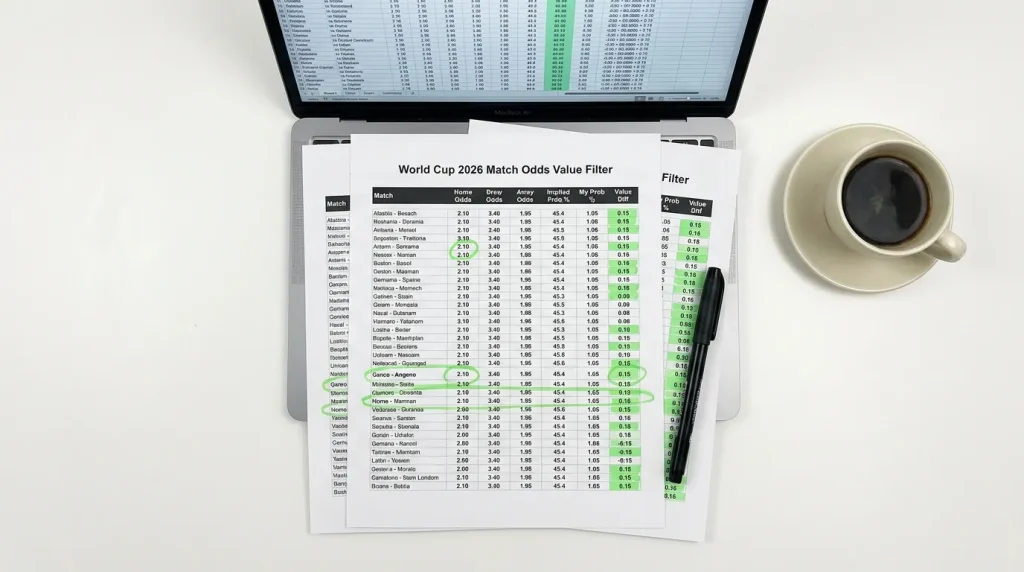
I apply all three filters sequentially. A bet must pass all three to earn a place in my tournament portfolio. At the 2022 World Cup, this system flagged 11 bets across the group stage, of which five returned a profit — a 45% strike rate at an average price of 3.40, producing a positive return on investment of roughly 14% across the portfolio. That is not a system that makes you rich overnight, but it is a system that keeps you in the game tournament after tournament, and over the course of a nine-year career, the compound effect of consistent positive ROI is substantial. If you are serious about betting on the best World Cup 2026 betting markets, a structured value framework is not optional — it is the foundation everything else sits on.
When to Bet: Pre-Tournament vs Matchday Lines
The single most expensive mistake I made at the 2022 World Cup was waiting too long to back Japan to beat Germany in their group opener. I had flagged the bet three weeks before the tournament at odds of 6.50. By the time I got around to placing it — the morning of the match — the price had contracted to 4.80. Japan won, and the bet still returned a profit, but the difference between 6.50 and 4.80 on a A$100 stake was A$170 in lost value. Timing is not a secondary consideration in World Cup betting. It is a primary edge, and for Australian punters operating under the online in-play ban, it is arguably the most important skill you can develop.
Pre-tournament odds — the prices available weeks or months before the first whistle — tend to be the most generous for outright and group-stage markets. Bookmakers open their World Cup books early to attract volume, and they accept a slightly wider margin of error in exchange for liquidity. As the tournament approaches and more information becomes available — squad announcements, injury updates, warm-up results — the lines tighten. By the time a match is 48 hours away, the odds reflect a much more complete information picture, and the opportunities for the educated punter narrow considerably.
My approach splits tournament betting into three timing windows. Window one is the pre-tournament phase, running from the moment the draw is finalised through to squad announcements. This is when I place my outright bets — tournament winner, top-4 finish, golden boot — because the prices are longest and the bookmaker’s margin of error is widest. For the 2026 World Cup, this window opened after the December 2025 draw and will close approximately two weeks before the opening match on 11 June. If you have done your analysis and identified value in outright markets, this is the time to act. Waiting until the eve of the tournament costs you percentage points on every price.
Window two is the squad-announcement phase, typically two to four weeks before the tournament. When coaches name their 26-man squads, the market recalibrates. A key injury or a surprise omission can shift group-stage lines by 10-15% in implied probability terms. This is the window where I place my group winner and group qualification bets, because I can now assess each team’s actual squad rather than a projected one. The information advantage here is not about knowing something the bookmaker does not — they see the same squad lists — but about reacting faster. If a bookmaker is slow to adjust their group winner price after a significant squad change, the window of value can last hours, not days.
Window three is the matchday window, from 48 hours before kickoff through to the final pre-match price. This is the domain of match result bets, Asian handicaps, and over/under goals. For Australian punters, this window matters more than it does for bettors in other jurisdictions because the online in-play ban means the pre-match price is your final price. There is no opportunity to hedge, cash out, or adjust your position once the match starts — at least not through online channels. That restriction sounds limiting, and in some ways it is, but it also forces a level of discipline that recreational punters in less regulated markets often lack. You do your analysis, you set your price, and you commit. The inability to second-guess yourself mid-match is, in my experience, a net positive for long-term profitability. If your World Cup 2026 predictions are grounded in solid pre-match analysis, the in-play ban becomes an advantage, not a handicap.
Odds Questions Punters Always Ask
After nearly a decade of writing about tournament odds, the same questions surface before every major competition. Here are the ones I hear most often from Australian punters preparing for the 2026 World Cup, answered without the usual hedging.
Turning Numbers Into an Edge
The 2026 FIFA World Cup will be the longest, largest, and most data-rich tournament in the history of the sport. For 39 days across three countries, 48 teams will generate a volume of betting markets that would have been unthinkable when I started covering this space in 2017. The sheer scale of it — 104 matches, hundreds of individual markets per fixture, an expanded knockout bracket that introduces a Round of 32 for the first time — means the bookmakers are operating in uncharted territory too. Their pricing models, built on decades of 32-team data, are extrapolating into a format they have never priced at the senior level. That is not a guarantee of easy money, but it is a structural advantage for the punter who does the work.
Everything in this guide comes back to one principle: odds are not predictions, they are prices. Like any price, they can be fair, generous, or exploitative, and your job as a punter is to tell the difference. Decimal odds give you the cleanest possible view of what the market thinks — convert them to implied probability, check the overround, compare against your own analysis, and bet only when all three filters align. That discipline is not glamorous. It will not produce a viral screenshot of a 500-to-1 multi coming in. But it will keep you solvent through 39 days of football, and when the final whistle blows at MetLife Stadium on 19 July, you will know that every punt you placed was grounded in analysis, not hope.
The Socceroos’ World Cup odds and every other price on your screen between now and kickoff are an invitation to think clearly under pressure. That is the real edge — not a system, not a model, but the willingness to read the numbers honestly and act on what they tell you. I have been doing this for nine years, and the numbers still surprise me. The 2026 World Cup will surprise all of us. The question is whether you will be positioned to profit from those surprises, or whether you will be the one funding someone else’s good fortune.
