
World Cup Multis: How I Build Tournament Accumulators That Last
 Available in US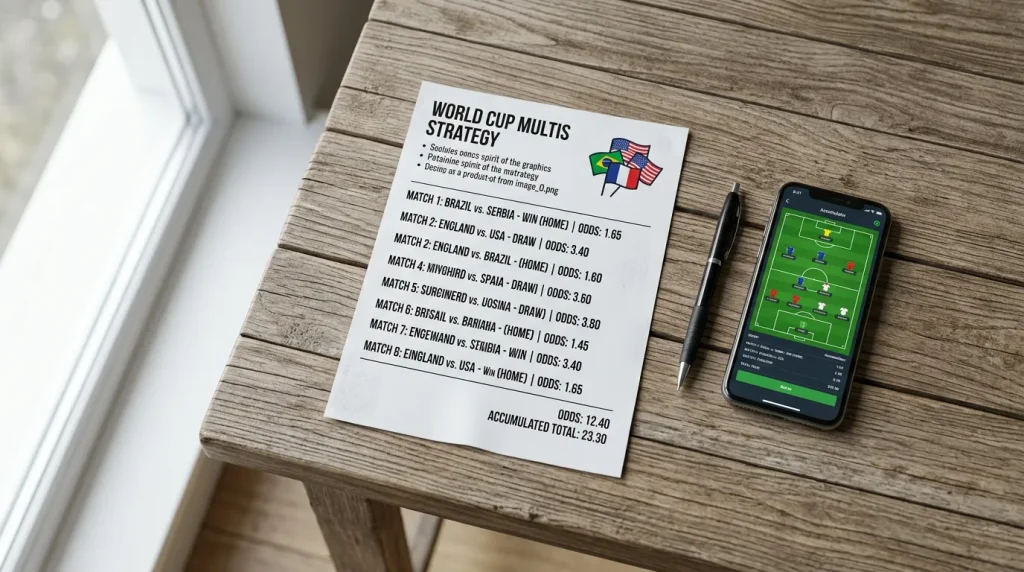
Table of Contents
Australians love a multi. I know this because I am one of them, and because the numbers are staggering — multi-bets account for a larger share of football wagering turnover in this country than in almost any other regulated market on earth. The appeal is obvious: small stake, big return, the thrill of watching legs land one by one across a World Cup matchday. The problem is equally obvious. Most multis lose. Not because the punters are stupid, but because the construction is wrong from the first leg. I have spent the better part of a decade building tournament accumulators for a living, and the difference between a multi that survives and one that combusts in the second match usually comes down to three mistakes that almost everyone makes.
The Three Mistakes Every Multi Punter Makes
A mate of mine — sharp bloke, reads form guides, watches every match — put together a six-leg multi for the 2022 World Cup group stage. Brazil to beat Serbia, Spain to beat Costa Rica, France to beat Australia, England to beat Iran, Argentina to beat Saudi Arabia, Germany to beat Japan. All favourites. All “safe.” Argentina lost. Germany lost. Two legs down, the whole slip was dead by day two. He had stacked six correlated risks and called it diversification.
That is mistake number one: confusing short prices with safe prices. A team at 1.30 to win is not safe — it is priced at roughly 77% implied probability, which means it loses nearly one in four times. Stack six of those and your combined probability of all six landing is around 21%. You are paying for a 21% chance at a combined price that suggests the same — the margin eats whatever edge you thought you had. Short-priced favourites in a multi are not building blocks. They are deadweight that drags your return-to-risk ratio into the dirt.
Mistake number two is ignoring correlation. If you back Brazil to win and the over 2.5 goals in the same match, those two outcomes are positively correlated — Brazil winning makes high-scoring more likely. Bookmakers price multi legs as if they are independent events, but they are not. Positive correlation between legs means the true probability of both landing is higher than the multiplied individual probabilities suggest, so the combined price is actually shorter than it looks. Negative correlation works the other way. Smart multi construction exploits both — deliberately including negatively correlated legs to increase the true combined probability relative to the advertised price.
Mistake number three is the big one, and it is psychological: treating the multi as a lottery ticket. When you build a multi purely for the payout size — “imagine if this ten-legger at $450 came in” — you have stopped analysing and started dreaming. Every leg in a multi needs to justify its inclusion on its own merits. If you would not back it as a single, it has no business in your accumulator. I apply this test ruthlessly, and it means most of my World Cup multis have three or four legs, not eight or ten. The payouts are smaller. The strike rate is dramatically higher.
My Multi Construction Method
Here is the actual process I follow, step by step. I am giving you the full method because I think transparency matters more than mystique, and because this approach has been profitable across three World Cup cycles.
Step one: I identify value singles. Before I even think about combining bets, I go through every group stage match and mark the selections where I believe the true probability exceeds the implied probability by at least 5%. If the market prices a team at 2.50 — implied 40% — I need to believe they win at least 45% of the time. This is where my pre-match analysis does the heavy lifting: squad depth, tactical matchups, travel schedules, historical performance at neutral venues. I typically find 8 to 12 value selections across a full group stage round of matches.
Step two: I check for correlation. I lay out my value selections and look for pairs that share a causal link. Two teams in the same group whose results affect each other’s qualification odds are correlated. A team’s match result and the total goals in that match are correlated. If two selections are positively correlated, I keep both only if the combined value still holds. If they are negatively correlated, they are golden — they effectively hedge each other within the multi, which means the true combined probability is higher than the bookmaker’s price implies.
Step three: I cap the legs. For World Cup multis, I never exceed four legs. The maths is simple. At four legs with an average single-bet probability of 55%, the combined probability is roughly 9%. At six legs, it drops to 2.8%. At eight legs, 0.8%. The difference between a 9% chance and a 0.8% chance is the difference between a strategy and a fantasy. Four legs keeps me in the zone where a well-constructed multi lands often enough to build bankroll over 104 matches rather than relying on one miracle slip.
Step four: I diversify across matchdays. A multi where all four legs play on the same day is emotionally thrilling and analytically lazy. If one matchday produces unusual conditions — extreme heat, a refereeing controversy, a viral illness sweeping through team hotels — all your legs are exposed. I spread legs across two or three matchdays, which also lets me adjust my final selections based on the results of earlier legs. Some bookmakers in Australia now offer “build your multi” tools that allow legs from different days, which is a structural advantage I exploit constantly.
Step five: I stake flat. Every multi gets the same stake — usually 1% of my tournament bankroll. No “confidence” multipliers, no doubling up after a loss. The temptation to overweight a multi you feel great about is the fastest route to a blown bankroll during a five-week tournament. I have seen it happen to punters far more experienced than me.
World Cup-Specific Multi Angles
Not all tournaments are equal, and the 2026 World Cup has structural features that create specific multi opportunities unlike any previous edition.
The first angle is the expanded group stage. Twelve groups of four means 48 matches in the first round alone. That volume is a multi builder’s paradise because it provides enough fixtures to find genuinely uncorrelated legs. In 2022, with eight groups, I sometimes had to force legs into a multi because the fixture list was too thin. In 2026, I expect to be spoiled for choice — and being selective is the whole point of this method.
The second angle is the best-third-placed-team rule. Eight of the twelve third-placed teams advance to the Round of 32. This changes the maths of group stage betting dramatically. A team that loses its first two matches can still qualify. That reduces the desperation factor in some matches and amplifies it in others — and the AH and match-result lines will not always price this correctly in the first tournament to use the new format. I plan to build multis around matches where the qualification incentive structure creates mispriced effort levels.
The third angle is time zones. The 2026 tournament spans three countries across four time zones, with kickoff times ranging from early morning to late evening. Matches played at different times of day in different climates produce different patterns — late-night fixtures in Houston’s heat will play differently to afternoon matches in Vancouver’s mild air. I factor these conditions into each leg, looking for situations where the match environment favours one side in a way the market underestimates.
The fourth angle is specific to Australian punters. Because in-play betting is banned online, the multi is your only mechanism for combining pre-match views across multiple matches into a single position. In markets where in-play is legal, punters can hedge or cash out mid-match. We cannot. That means the construction phase — the part before you hit “place bet” — carries more weight. A well-built multi in Australia is a more committed position than the same multi in the UK, and the discipline I have described above is not optional. It is the only protection you have once the first whistle blows.
One practical tip I will share: during the group stage, I run two separate multi portfolios. The first is a “chalk” portfolio — three or four legs of moderate-priced selections in the 1.60-2.20 range, aiming for combined odds of 8.00-15.00. The second is a “roughie” portfolio — three legs of longer-priced selections at 2.80+, aiming for combined odds of 25.00-60.00. The chalk portfolio is designed to land roughly once every 8-12 attempts. The roughie portfolio is a longer shot but constructed with the same discipline — every leg individually justified, correlation checked, conditions assessed. The two portfolios together give me exposure across the risk spectrum without compromising the method on either end.
Multi Betting Questions
A Smarter Way to Stack Legs
The World Cup multi is Australia’s favourite tournament bet, and it deserves better than the slapdash construction most punters give it. The 2026 World Cup will deliver 104 matches across 39 days — an unprecedented volume of opportunities to build disciplined, value-driven accumulators. If you take one thing from this piece, make it this: every leg earns its place or it does not get in. The payout takes care of itself when the process is right. I will be running this exact method from the opening match at Estadio Azteca to the final at MetLife, and I expect the four-leg discipline to matter more than ever in a tournament this large.
