
Pre-Match World Cup Betting: Why It Is the Only Game for Aussie Punters
 Available in US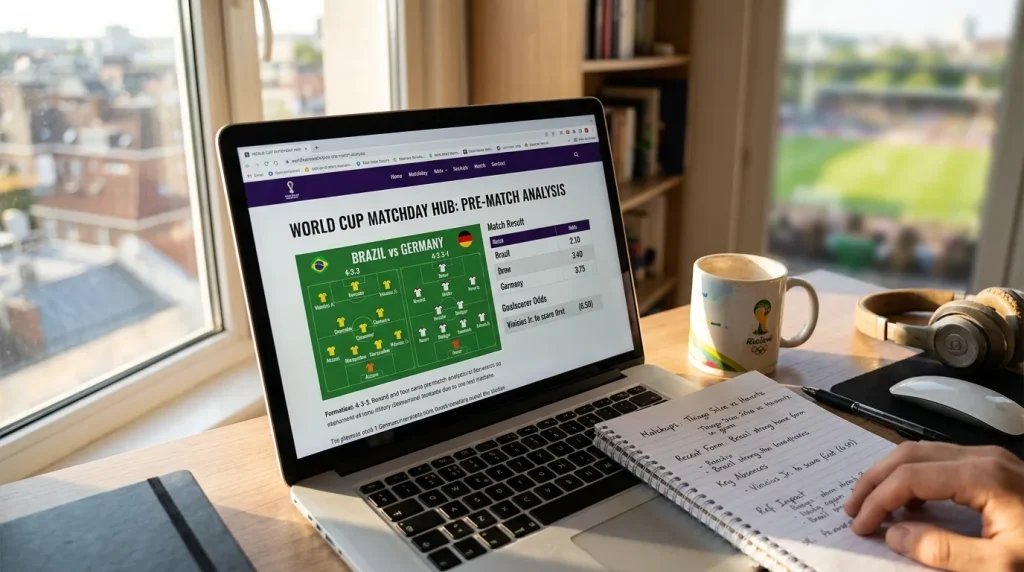
Table of Contents
If you live in the UK or most of Europe, you can bet on a World Cup match while it is happening — adjust your position at half-time, hedge when the red card lands, cash out when the momentum shifts. If you live in Australia, you cannot. The Interactive Gambling Act makes online in-play betting illegal. Every dollar you wager on the 2026 World Cup goes on before the referee blows the first whistle. That sounds like a disadvantage. After nine years of tournament analysis, I am convinced it is the opposite. Pre-match World Cup betting forces discipline, rewards preparation, and eliminates the impulsive live-betting decisions that drain more bankrolls than bad tips ever will.
The In-Play Ban and What It Actually Means for You
I was at a mate’s place during the 2022 World Cup semi-finals, watching Argentina play Croatia. A friend in London was texting live updates of his in-play bets — he had backed Argentina at half-time, then hedged with a Croatia goal line after Alvarez’s second, then taken a cash-out that left him with a A$12 profit on what started as a A$50 position. He had spent 90 minutes glued to his betting app, made four separate decisions under time pressure, and walked away with less than a quarter of his original stake. I had placed one pre-match bet — Argentina -0.75 on the Asian handicap at 1.82 — and collected A$91 without touching my phone after kickoff. The difference was not luck. It was structure.
Under the Interactive Gambling Act 2001, amended in 2016, Australian-licensed bookmakers cannot accept online bets on events that have already started. The only exception is telephone betting — you can call a bookie and place an in-play bet verbally, but the friction of picking up the phone, waiting on hold, and dictating your bet means almost nobody does it during a fast-moving football match. In practice, if you are an Australian punter, you are a pre-match punter. Full stop.
The ban applies to all online wagering with Australian-licensed operators. It does not prevent Australians from accessing offshore betting sites, but those operators are unlicensed, unregulated, and offer none of the consumer protections — including BetStop self-exclusion — that the domestic framework provides. I do not use them and I do not recommend them. The regulated market is where I operate, and the pre-match constraint is a feature of that market I have learned to work with rather than around.
What the ban means practically is this: your analysis window closes at kickoff. Every insight, every data point, every gut feel has to be processed and converted into a betting position before the match starts. There is no second chance, no adjustment, no hedge. That finality sharpens your thinking in a way that in-play punters never experience. When you know you cannot fix a mistake after kickoff, you make fewer mistakes before it.
My Pre-Match Analysis Method
The morning of every World Cup match I plan to bet on, I run through a five-step process. It takes 30 to 45 minutes per match, and I have refined it across three tournament cycles. The process is not secret — the edge comes from doing it consistently, not from any single proprietary insight.
Step one is squad news. I check confirmed lineups the moment they drop — typically 60 to 90 minutes before kickoff at a World Cup. Lineup changes are the single highest-impact variable in pre-match analysis because they are not fully priced until they are public. When a key player is unexpectedly rested or injured, the market moves fast — but not instantly. There is a window of 5 to 15 minutes between lineup release and full market adjustment. If I have done my homework on likely XIs during the week, I can identify the significance of a change faster than the market corrects. This is where being awake at the right time matters — and for Australian punters, the 2026 World Cup schedule is unusually kind. Matches will kick off between 5:00 AM and 3:00 PM AEST during the group stage, meaning lineups drop between 3:30 AM and 1:30 PM. The afternoon fixtures are perfectly timed for a morning analysis session before the Australian workday starts.
Step two is tactical matchup assessment. I look at how each team has set up in their most recent competitive matches — formation, pressing intensity, defensive line height, set-piece routines — and identify the specific mismatches that will determine the margin. A team that presses high against a team that builds out from the back creates a different match profile than two deep-sitting sides waiting for transitions. I am not modelling expected goals or running simulations. I am reading the tactical landscape and asking a simple question: what does this match look like at the 60-minute mark? The answer shapes whether I back the favourite, the underdog, the over, the under, or the handicap line.
Step three is environmental factors. At the 2026 World Cup, this matters more than at any previous edition. Matches will be played across three countries, four time zones, and climatic conditions ranging from Houston’s summer humidity to Vancouver’s temperate coast to Mexico City’s 2,200-metre altitude. Altitude is the factor most punters ignore and most bookmakers underweight. Teams playing at Estadio Azteca face a significant physical disadvantage if they are not acclimatised — reduced oxygen availability affects sprint recovery, pressing intensity and late-game endurance. I adjust my expectations for any match at altitude, typically shifting the handicap line 0.25 goals towards the acclimatised side.
Step four is rest and travel. The 2026 schedule, with matches spread across venues thousands of kilometres apart, creates recovery differentials that did not exist at compact tournaments like Qatar 2022. If Team A has had four rest days and Team B has had three — and Team B also flew from Miami to Seattle between matches — the physical edge sits with Team A. I track rest days and travel distances for every team and weight them in my assessment. A half-day travel difference might not sound like much, but across a 39-day tournament where matches come every 4-5 days, the cumulative effect is measurable.
Step five is line comparison. I check the odds across three or four Australian-licensed bookmakers, looking for the best available price on my selected bet. Price differences of 0.05-0.10 in decimal odds are common between operators, and over a tournament of 30-40 bets, consistently taking the best price adds 2-3% to my return. This is the simplest edge in the entire process — it costs nothing, takes two minutes, and is available to every punter in the country.
Timing Your Bets: When Lines Move and Why
There is a widespread belief that the best pre-match odds are available the moment the market opens, days before the match. In my experience, that is only half right. Early markets offer the best value on outcomes where the market has not yet received information — the line is set by the bookmaker’s model, and sharp money has not landed yet. But early markets are also the widest — the margin is highest because the bookmaker is protecting against uncertainty.
The optimal betting window, in my assessment, varies by bet type. For outright and tournament markets — winner, top four, group winner — early is better. These markets get hammered by sharp money in the weeks before the tournament, and the value compresses quickly. I place my outright bets months in advance and rarely adjust them.
For match-level markets — 1X2, Asian handicap, totals — the best window is 60 to 90 minutes before kickoff, after lineups are confirmed but before the market fully adjusts. This is the sweet spot where information asymmetry is highest. If I have spent the morning analysing the match and a lineup change drops that confirms my thesis, I can act before the bookmaker’s automated systems and the weight of public money push the line to its final resting place.
The worst time to bet is the 24-hour window between the day before the match and the lineup announcement. In that period, the market is mostly efficient — all the pre-match analysis is priced in, but the lineup information is not yet available. You are betting blind in the one area that matters most. I avoid placing any match bet in that window unless the line has moved for reasons I can identify and disagree with — in which case, the move itself creates the value.
For the 2026 World Cup, Australian time zones create a practical advantage. Group stage matches kick off between 5:00 AM and 3:00 PM AEST. Lineups will drop between 3:30 AM and 1:30 PM AEST. The afternoon and evening matches — which is when most European punters are active and the market is busiest — arrive in the Australian morning, giving you a calm analysis window before the rush of European money arrives. I genuinely believe Aussie punters have a structural timing edge at this particular World Cup that we have never had before.
Pre-Match Betting Questions
Making the Ban Work for You
The in-play ban is not going away. The April 2026 reforms tightened advertising restrictions, but the core prohibition on online live betting remains embedded in the Interactive Gambling Act with no political appetite for change. That means pre-match World Cup betting is the game, and the punters who master it will outperform those who resent the restriction. My method — squad news, tactical matchup, environmental factors, rest and travel, line comparison — is not complicated. It is thorough. And at a 104-match tournament spanning three countries and 39 days, thoroughness is the edge that compounds. Every match you analyse properly before kickoff is a match where you are better prepared than the punter who opens the app five minutes before and taps the favourite. That gap, repeated across 30 or 40 bets, is the difference between a profitable World Cup and a frustrating one.
