
Asian Handicap Betting at the World Cup: My Go-To Market
 Available in US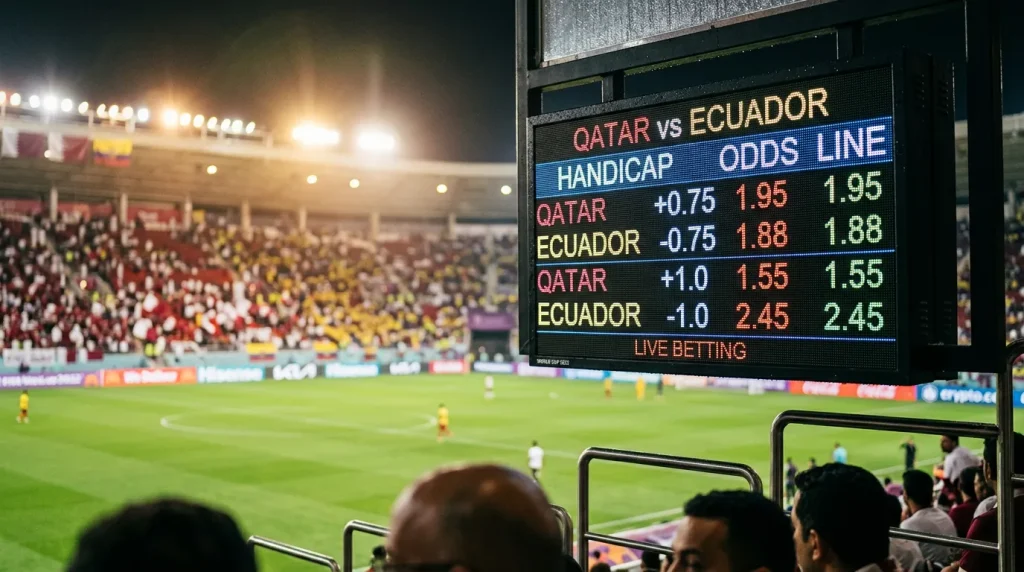
Table of Contents
Nine years of covering international tournament wagering markets, and Asian handicap is still the first line I check every single morning during a World Cup. Not the 1X2. Not the over/under. The AH line. I have watched punters pour money into head-to-head markets at inflated margins for years, chasing the comfort of simplicity while the sharper edge sat one click away. When the 2026 FIFA World Cup kicks off across North America, with 48 teams and 104 matches crammed into 39 days, the volume of group stage fixtures alone will create AH opportunities that most recreational punters will never even see.
Asian handicap betting at the World Cup strips the draw out of the equation — and in tournament football, draws are the variable that blows up more multis and match bets than any other result. The 2022 World Cup in Qatar produced 13 draws across 64 matches. With 104 matches in 2026 and a new format that incentivises caution in the third group game, that number could climb. Every draw you can neutralise from your betting slip is a step closer to consistent returns. This is the market where I have built the majority of my tournament profits, and I am going to walk you through exactly how I use it.
Why Asian Handicap Is My Favourite World Cup Market
Back in 2018, I placed a head-to-head bet on Germany to beat South Korea in the group stage. Germany were 1.22 to win. South Korea won 2-0. That was A$400 gone on a result the market priced at a 5% chance. The thing is, I knew Germany looked sluggish. I knew their body language after the Mexico loss was wrong. But the 1X2 market gave me no way to express that view without either backing South Korea outright at 15.00 or sitting on my hands. Asian handicap would have let me back South Korea +1.5 at around 1.85 — a bet that paid out comfortably and actually reflected my read on the match.
That experience crystallised something I had been circling for years: the 1X2 market in tournament football is a blunt instrument. It forces you into three rigid outcomes when the real question is usually about margins. Will the favourite win by enough? Can the underdog keep it close? Asian handicap lets you bet on the margin of the match rather than the binary result, and in a World Cup — where motivation, fatigue, altitude, travel and group dynamics shift wildly between matchdays — margin is where the analytical edge lives.
The structural advantage is the reduced margin. Bookmakers typically run AH lines at 3-4% overround compared to 6-8% on the 1X2. Over a 104-match tournament, that difference compounds. If you are placing 30-40 bets across the group stage and Round of 32, paying 3% less margin per bet is the equivalent of getting one or two free bets over the tournament. It is not glamorous. It is not the kind of thing that makes for exciting pub chat. But it is the reason professional syndicates — the ones moving six and seven figures through Asian books — rarely touch the 1X2 at all.
For Australian punters specifically, there is another layer. In-play betting is banned online under the Interactive Gambling Act. That means every cent you wager goes on before kickoff. When you are locked into a pre-match position, you want the market that gives you the most precise expression of your opinion. Asian handicap does that better than anything else on offer.
Reading the Lines: A Punter’s Walkthrough
I remember the first time I looked at an AH line and thought it was a typo. Argentina -1.25 at 1.95. What does a quarter-goal handicap even mean? If you have had that moment of confusion, you are not alone — and I promise the logic is simpler than it looks once you see it in action.
A whole-number handicap is the starting point. If you back Australia +1.0 against the USA, you are giving the Socceroos a one-goal head start. If the USA win by exactly one goal, your stake is refunded — that is the “push” mechanic that makes AH unique. If Australia lose by two or more, you lose. If they draw or win, you collect. The push eliminates the sting of the exact-margin loss, which in tournament football happens far more often than the market implies.
Half-goal lines remove the push entirely. Australia +0.5 means you win if Australia draw or win, and you lose only if they lose by any margin. There is no refund scenario. These are the cleanest AH bets — two outcomes, no ambiguity. The 2022 World Cup group stage saw 14 matches decided by exactly one goal. On a +0.5 line, every one of those losing sides would have been a push on the whole number but a loss on the half. The precision matters.
Quarter-goal lines — the ones that confused me initially — are split bets. When you back a team at +0.75, half your stake goes on +0.5 and half on +1.0. If the team loses by exactly one goal, you lose the +0.5 half and push on the +1.0 half, getting back 50% of your total stake. It is a compromise position, and in tournament football, these quarter lines are where I find the most value. Bookmakers often struggle to price the gap between a half and a whole number accurately in one-off fixtures between teams that rarely play each other — exactly the scenario that dominates a World Cup group stage.
Let me put real numbers on it. Say France are -1.25 against Iraq in Group I, priced at 2.05. You put A$100 on France -1.25. If France win 3-0, both halves win: you collect A$205. If France win 2-1, the -1.0 half pushes and the -1.5 half loses: you get A$50 back, losing A$50 net. If France win 1-0, both halves lose. The line is telling you the market thinks France will win by roughly 1.5 goals — the quarter line tilts the risk slightly towards the favourite compared to a clean -1.5. Understanding that tilt is where you start reading AH lines like a professional instead of a tourist.
One more nuance that trips people up: AH lines move faster and more aggressively than 1X2 prices. The reason is liquidity. Asian books move billions through these markets, and when sharp money lands on one side, the line shifts within minutes. If you see a line move from -0.75 to -1.0 an hour before kickoff, that is significant information — it means informed money has come in on the favourite. I track line movements on every Socceroos match as a matter of habit, because the movement tells me what the market knows that I might not.
Applying AH to Tournament Football
A friendly between two mid-ranked sides and a World Cup group decider are two completely different beasts, and AH lines reflect that — sometimes accurately, sometimes not. The specific dynamics of tournament football create patterns in handicap markets that repeat every four years, and recognising them is half the battle.
The first pattern is the “dead rubber” collapse. When a team has already qualified from the group, their AH line in the final match almost always shortens — the market prices in rotation and reduced motivation. At the 2022 World Cup, France had already topped Group D when they played Tunisia in the final game. France were around -0.75 pre-tournament for that fixture. By matchday, the line had drifted to -0.25. Tunisia won 1-0. The punters who recognised the dead rubber dynamic and backed Tunisia on the AH cleaned up. With 12 groups of four teams in 2026 and the top two plus the best eight third-placed sides advancing, dead rubbers will be rarer — but the principle still applies when the maths is done early.
The second pattern is what I call the “desperate underdog.” In the final group match, a team that must win to survive plays with an intensity that bookmakers consistently underestimate. Japan’s 2-1 comeback against Spain in 2022 is the textbook case. Japan were +0.75 on the AH. They did not just cover — they won outright. The desperation factor in tournament football is more powerful than in any league context because there is no next week. When a team’s World Cup survival depends on the next 90 minutes, the effort level exceeds anything you would see in a domestic fixture. I look for these spots obsessively during the second and third rounds of group matches.
The third pattern relates to the expanded format. With 48 teams, the quality gap between the top and bottom of each group widens. Group E has Germany and Curacao. Group C has Brazil and Haiti. These mismatches will produce AH lines of -2.5 or wider — territory where the favourites routinely win but fail to cover. At the 2022 World Cup, the average margin of victory in matches where the favourite was -2.0 or wider on the AH was 2.3 goals. That means the favourite covered the spread roughly half the time. In mismatches, the value almost always sits with the underdog on the AH, not the favourite. The crowd piles on the big name at -2.5, and the dog at +2.5 quietly pays out more often than the market expects.
For Group D — the Socceroos’ group — I expect AH lines of roughly USA -0.75, Turkiye -0.25 against Australia, and Australia -0.25 against Paraguay. These tight lines are exactly where AH shines, because a single goal swings the outcome in either direction and the push mechanic protects your downside. If you are backing Australia +0.75 against the USA, you are saying “I think the Socceroos can keep this close” — a much more defensible position than backing the Socceroos to win outright at 4.50 on the head-to-head.
One tournament-specific factor that casual punters miss entirely: rest days between group matches. The 2026 schedule gives some teams four days between fixtures and others only three. A one-day difference in recovery across a 39-day tournament is enormous — and it is not always priced into the AH line. I cross-reference the match schedule with the AH before every bet, looking for situations where a fresher side faces a team on short turnaround. The bookmakers are getting better at this, but with 104 matches to price, they cannot get every line right.
Asian Handicap Questions
The Market That Separates Punters From Mugs
I have spent nine years watching punters leave money on the table by ignoring Asian handicap at World Cups. The market is not complicated — it just requires a five-minute investment in understanding the mechanics, and then it rewards you with lower margins, sharper lines and more precise expression of your match analysis. When the 2026 World Cup opens with 48 teams spread across 16 venues in three countries, the sheer volume of group stage fixtures will create AH value every single matchday. The punters who learn to read these lines before the tournament starts will have a genuine edge over those still clicking on the 1X2 tab out of habit. Asian handicap betting at the World Cup is not a niche — it is the market where the serious money lives, and it is the first place I will be looking when the Socceroos walk out at BC Place on 13 June.
